


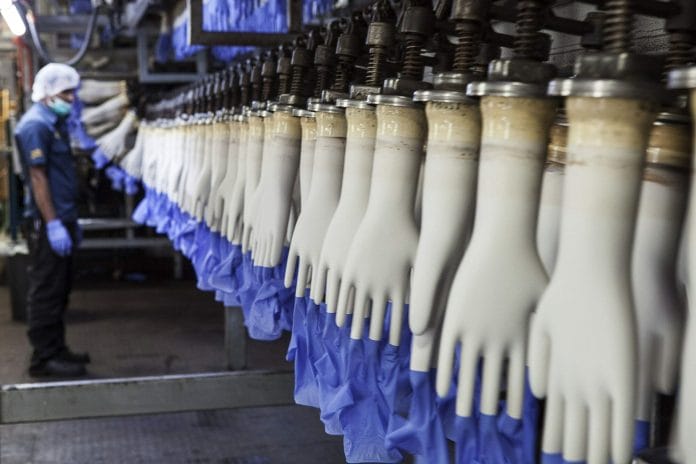
The US’ decision to temporarily slash import tariffs on Chinese goods, including rubber gloves, has introduced fresh uncertainty into the global glove market, raising concerns for Malaysian glove manufacturers that have long dominated exports to the US, CIMB Securities Sdn Bhd said.
Effective May 14, 2025, the US will reduce tariffs on Chinese imports from 145% to 30% for a 90-day period, while China reciprocates by lowering tariffs on US goods from 125% to 10%. This temporary reprieve, announced in a joint US-China statement, is set to last through mid-August and may be extended or revised following further negotiations.
According to CIMB Securities, the tariff reduction reduces the pricing gap between Chinese and Malaysian glove exports to the US, a shift that could weigh on Malaysia’s relative competitiveness in its largest export market.
“However, Malaysian gloves remain subject to a significantly lower tariff of 10% compared to 80% for Chinese gloves under revised effective rates through 2025, rising to 130% from January 2026,” the research house said in a note.
Its analysts noted that Malaysian manufacturers still retain a pricing advantage, with average selling prices (ASPs) at US$20-US$21 per 1,000 pieces, while Chinese producers would need to offer gloves at US$11-US$12 to stay competitive, a level deemed unsustainable over the long term.
Meanwhile, Malaysia continues to lead the global rubber glove market, commanding an estimated 45% share by volume in 2024, followed by China at 30%-35%.
In the US alone, Malaysian gloves account for 47% of total imports, according to data from the Investment, Trade and Industry Ministry.
Since the US imposed higher tariffs in late 2024, Chinese glove producers have redirected shipments toward other regions, intensifying price competition in Europe and other non-US markets, where ASPs are now 10%-20% lower than those in the US.
Despite the near-term headwinds, CIMB Securities analysts maintain a ‘NEUTRAL’ outlook on the glove sector, citing ongoing policy uncertainty, subdued demand and increased competition.
The market expects global buyers to diversify sourcing amid continued volatility, while US buyers adopt a “wait-and-see” stance through the first half of 2025 (1H25).
The analysts added that valuations across the sector remain in line with post-pandemic norms at 1.5 times CY26F price-to-book value, reflecting expectations of a gradual recovery in earnings by 2H25.

