



By Abdul Rahman, Deputy Editor at BusinessToday Malaysia
If you are planning to buy a new car after June 2026, your loan will quietly look very different under the hood – even if the showroom salesman’s pitch sounds the same.
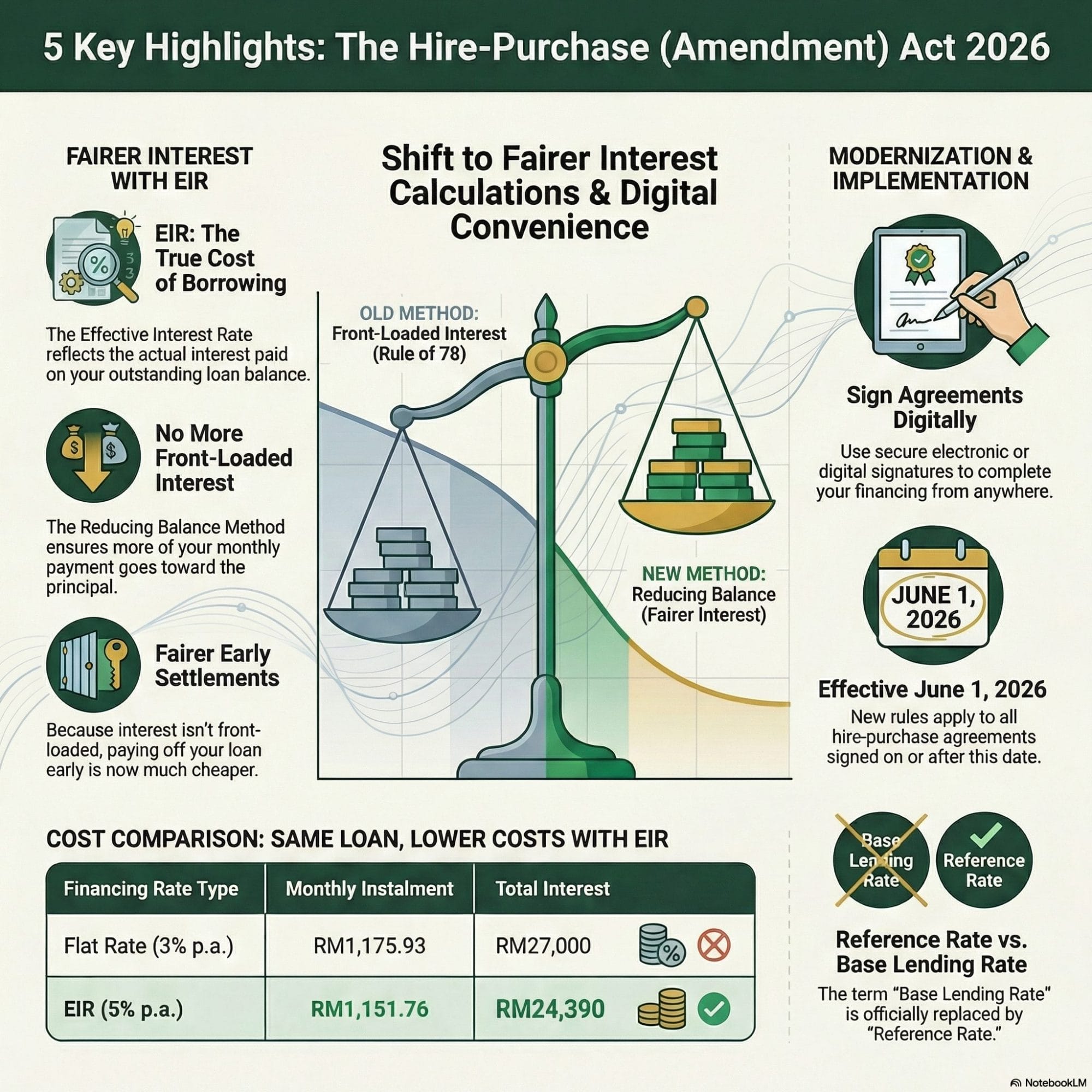
With the Hire‑Purchase (Amendment) Act 2026 taking effect on 1 June, car loans in Malaysia will move away from flat rates and the notorious Rule of 78 method, and into a world of effective interest rates (EIR) and reducing‑balance calculations. On paper, that sounds like technical jargon. In reality, it could change how much interest you pay, how easily you can compare offers, and how early you dare to settle your loan.
Goodbye flat rate, goodbye Rule of 78
Today, when you walk into a showroom, you are usually quoted a “flat rate” – say 2.7% or 3% – and a monthly installment. What you are almost never told clearly is that this flat rate is applied to the full original principal for every year of the tenure, and that under the Rule of 78 method, much of your early installments go towards interest, not the principal.
That front‑loading means if you decide to settle your loan early, upgrading your car in year three of a nine‑year tenure, for example; you discover you have already paid most of the interest upfront and still owe a surprisingly large principal when you ask for the settlement figure. BNM itself describes the Rule of 78 as “widely criticised for being inequitable, particularly for customers who repay their loans early”, and notes that many countries have banned it for exactly this reason.
The new law abolishes both flat‑rate marketing and the Rule of 78. Instead, all new hire‑purchase loans – fixed or variable – must use EIR and a reducing‑balance method, where interest is calculated only on the outstanding principal, similar to a housing loan. Once you clear the principal, no more interest accrues. That is a fundamentally fairer system for anyone who intends to pay down faster or keep their options open.
For new car owners, what actually changes?
If you sign a new car loan after 1 June 2026, three practical things will be different:
- You’ll see EIR instead of flat rate.
- Lenders must quote and disclose the effective interest rate, not just a flat percentage, and rate caps are set at 17% EIR for loans up to five years and 16% for tenures over five years, with 17% for variable‑rate loans.
- EIR better reflects the true cost of borrowing because it factors in the amortisation schedule, fees and how much principal you have outstanding at each point in time. Lower EIR, less interest – simple as that.
- Early settlement will hurt a lot less.
- With reducing‑balance interest, if you pay more in the early years or settle the loan ahead of schedule, you will genuinely save on interest because interest is charged on a shrinking principal, not on the original amount as if nothing has changed.
- Under the old Rule of 78 model, borrowers who settled early often felt “punished” because most of their instalments had gone to interest; the new structure removes that hidden penalty.
- You will sign and receive more things digitally.
- The Act explicitly allows e‑signatures and digital delivery of hire‑purchase agreements, as long as identity checks and due diligence are properly done.
- For new buyers, that means faster approvals, less paperwork, and in theory, easier access to documentation if you want to double‑check terms before you sign.
In short, for new car owners, the law doesn’t magically slash installments, but it does make pricing more honest, comparisons easier, and early exit less punishing.
What about the “goodwill discounts” everyone is talking about?
You may have seen headlines about banks giving discounts to customers who settle early. That sounds like free money – but here is the nuance.
The goodwill discounts are not for new car buyers. They are a one‑off transition measure for existing fixed‑rate hire‑purchase loans that still use the Rule of 78, so that if those customers choose to settle early after June 2026, their outstanding balance is brought closer to what it would have been under the new reducing‑balance method. Industry associations ABM, AIBIM and ADFIM have committed to offering these discounts from 1 June 2026 to 31 March 2027, subject to conditions like being up to date on payments and not under legal action or restructuring.
CIMB Securities, in a note on the sector, calls the impact of these goodwill discounts on bank earnings “negligible” because early settlements are a small share of hire‑purchase books and usually happen mid‑cycle when there isn’t much unearned interest left. In other words, this is more about fairness and optics than a big transfer of value from banks to borrowers. It smooths the transition; it doesn’t rewrite the economics of car financing.
Will new car loans be cheaper?
This is the uncomfortable question many potential buyers will ask: does EIR + reducing balance mean a cheaper car loan? The honest answer is: not necessarily.
If you run a full seven‑ or nine‑year tenure to maturity, the total amount of interest you pay under the new method will be similar to what you would have paid under a properly priced flat‑rate loan.
The Act doesn’t cap profit margins at new, ultra‑low levels; it caps EIR at 16–17%, which are high ceilings, not the typical market rates most people see.
Where you do gain is in transparency and flexibility:
- You can compare two offers more meaningfully because both must show EIR and use the same basic calculation method.
- If you choose a shorter tenure, pay extra each month, or sell the car early, you will actually see the benefit in lower interest paid rather than discovering that most of your installments went to interest anyway.
So, if you walk into a showroom in 2027, you should not expect the sales associate to say, “The law has changed, and so your monthly instalment is now 20% lower.” Instead, you should expect clearer disclosure of EIR, more comparable offers across banks, and a loan structure that doesn’t quietly punish you for wanting to get out early.
What new buyers should do differently now
From a new car owner’s perspective, the Act shifts part of the responsibility back to you. It arms you with better information; it doesn’t make the decision for you. Three habits will matter more:
- Look at EIR first, monthly instalment second.
A lower installment can be the result of stretching tenure, not cheaper credit. EIR tells you the real cost of the loan; use it to compare banks, not just “RMX per month” banners. - Think about your likely holding period.
If you know you often change cars after three to five years, the new rules are good news – you no longer face as steep a penalty for early settlement. But that also means you should consciously pick tenures and payment plans that match your realistic horizon, rather than defaulting to nine years because it “feels lighter” each month. - Beware of variable‑rate temptations.
Variable‑rate hire‑purchase remains allowed with a 17% EIR cap, and in a low‑rate environment, these could look attractive. But remember that EIR can move over time; you are trading rate certainty for potential savings. New owners will need to be more honest with themselves about income stability and risk tolerance.
Fairer rules are not the end of the story
BNM and the government are selling the Hire‑Purchase (Amendment) Act as part of a broader push to modernise consumer credit and align Malaysia with global best practices. On that front, they’re largely right: banning Rule of 78, forcing EIR disclosure and standardising reducing‑balance loans are long overdue wins for car buyers.
But as someone who talks to households and businesses every day, I’d caution against overselling what this law can do. It makes car loans fairer and more transparent; it does not make cars more affordable by itself. Prices are still driven by taxes, margins, currency and global supply chains.
For new car owners, the real opportunity of 2026 is not a sudden bargain, but a chance to finally understand in plain numbers – what you are signing up for, and to use that understanding to negotiate better, compare smarter, and, if you’re disciplined enough, get out of debt earlier without feeling trapped by the fine print.


