


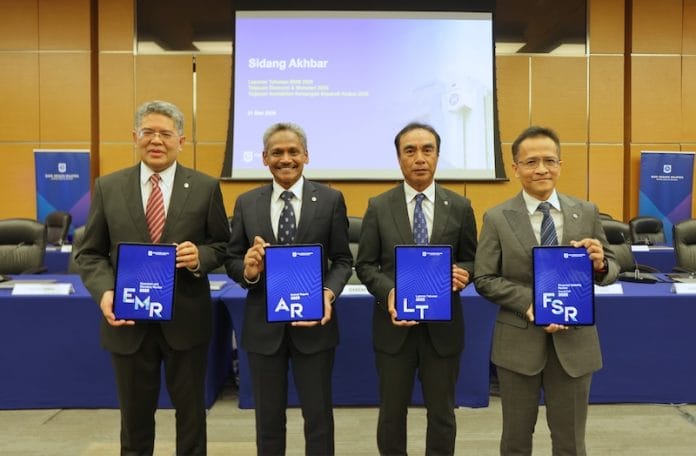
Bank Negara Malaysia (BNM) expects Malaysia’s economy to remain resilient in 2026, supported by strong domestic demand, steady investments and a robust financial system, despite rising global uncertainties driven by geopolitical tensions and trade fragmentation.
In its Annual Report 2025, Economic and Monetary Review 2025, and Financial Stability Review for the second half of 2025, the central bank said the global economy is undergoing structural shifts, with geopolitics, tariffs and supply chain realignments increasingly shaping economic outcomes.
BNM projected global growth to moderate to between 2.7% and 3.2% in 2026, weighed down by trade tensions and geopolitical risks, including ongoing conflicts in the Middle East that have heightened energy market volatility and inflationary pressures.
Malaysia’s strong footing
Against this backdrop, Malaysia recorded solid economic performance in 2025, with GDP growth of 5.2% and low inflation at 1.4%. The ringgit also strengthened, supported by both global and domestic factors.
Looking ahead, BNM forecasts Malaysia’s economy to expand between 4% and 5% in 2026, underpinned by:
- Resilient household consumption amid steady income growth and low unemployment of around 2.9%;
- Continued investment momentum, with approved investments reaching RM427 billion in 2025;
- A diversified export base, supported by electrical and electronics (E&E) and rising demand linked to artificial intelligence (AI) and digital infrastructure.
The central bank noted that Malaysia’s E&E sector is well-positioned to benefit from the global tech investment cycle, particularly in advanced packaging and semiconductor-related activities.
Tourism is also expected to remain a key growth driver, with spillover benefits across retail, transport and hospitality sectors ahead of Visit Malaysia 2026.
Inflation and policy outlook
BNM projects headline inflation to range between 1.5% and 2.5% in 2026, with domestic policy measures helping to cushion the pass-through of global cost pressures.
The central bank reiterated its commitment to maintaining price stability while supporting sustainable growth, noting that monetary policy will remain responsive to evolving risks. It highlighted last year’s 25-basis-point reduction in the Overnight Policy Rate (OPR) as a pre-emptive move to support economic resilience.
Financial system remains robust
BNM emphasised that Malaysia’s financial system continues to operate with strong capital buffers and ample liquidity, enabling banks to support lending even under stress scenarios more severe than past crises.
Households and businesses also maintain healthy balance sheets, with low levels of impaired loans and stable debt-servicing capacity.
Credit flow to the economy remains intact, with financing continuing to support both consumption and investment activities.
Structural reforms and future priorities
The central bank underscored ongoing efforts to strengthen long-term economic resilience through structural reforms, including:
- Advancing value-based finance and sustainable investments;
- Enhancing digital payments infrastructure and financial inclusion;
- Strengthening fraud prevention, which helped avert RM1.2 billion in losses in 2025;
- Addressing healthcare cost pressures through the RESET initiative.
BNM is also developing the next Financial Sector Blueprint, focusing on catalysing growth, strengthening financial system foundations and supporting innovation.
Risks remain
Despite the positive outlook, BNM cautioned that risks remain tilted to the downside, largely from external factors such as slower global trade, geopolitical tensions and commodity-related uncertainties.
“Malaysia enters 2026 from a position of strength, but strength does not mean total immunity,” the central bank said, noting that continued reforms, investment execution and policy agility will be key to sustaining growth.
Overall, BNM said Malaysia is well-positioned to navigate global headwinds, supported by diversified growth drivers, a resilient financial system and sufficient policy space.


