


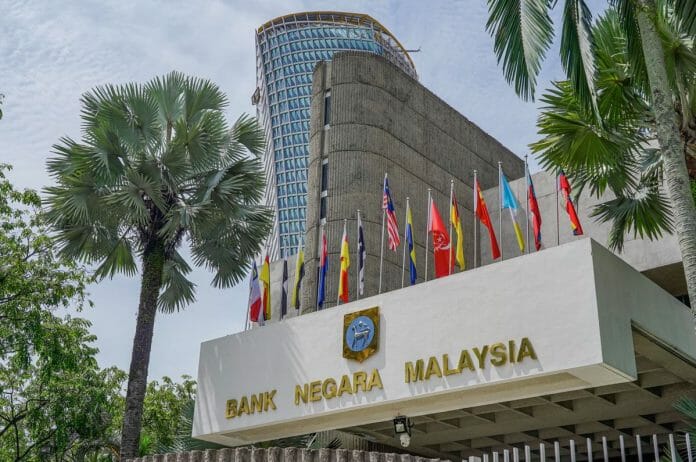
Research firm BMI expects Bank Negara Malaysia (BNM) to maintain the Overnight Policy Rate (OPR) at 2.75% for the remainder of 2026, citing resilient economic growth and manageable inflationary pressures.
The forecast came after BNM kept the benchmark interest rate unchanged during its Monetary Policy Committee meeting on 7 May, in line with expectations from economists surveyed by Reuters.
BMI said the central bank’s latest policy statement adopted a slightly more cautious tone but largely maintained its existing forward guidance, signalling continued confidence in the domestic economy.
The research house expects BNM to remain on hold again at its next policy meeting on 9 July, noting that inflation remains well contained despite higher global commodity prices and recent increases in unsubsidised fuel prices.
Malaysia’s headline inflation rose slightly to 1.7% year-on-year in March 2026 from 1.4% in February, but BMI said the figure remained comfortably within the government’s target range of 1.5% to 2.5%.
The firm maintained its full-year inflation forecast at 1.9% for 2026, arguing that existing subsidy measures would continue to cushion the impact of elevated global energy and commodity prices.
BMI also highlighted the resilience of Malaysia’s domestic economy, supported by firm consumer demand and improving labour market conditions. Services sector wages expanded for a seventh consecutive quarter, rising 5% year-on-year in the fourth quarter of 2025, while the unemployment rate stood at a 12-year low of 2.9% in February 2026.
The external sector also continued to show strength, with exports growing 12.7% year-on-year in the first quarter of 2026, largely driven by sustained demand linked to artificial intelligence-related technologies and the ongoing global semiconductor upcycle.
BMI said Malaysia’s electronics and electrical (E&E) exports would likely continue supporting the country’s trade surplus amid strong global semiconductor sales.
Despite its stable rate outlook, BMI noted that risks remain tilted towards a potential rate cut should economic growth weaken more sharply than expected.
The firm warned that a prolonged Middle East conflict could eventually weigh on global demand and Malaysia’s trading partners, even though higher oil prices may initially benefit the country as a net energy exporter.
BMI currently forecasts Malaysia’s economy to grow 4.3% in 2026, moderating from 5.2% in 2025, while expecting the ringgit to strengthen to RM3.80 against the US dollar by end-2026 on the back of robust foreign direct investment inflows and resilient economic fundamentals.


