


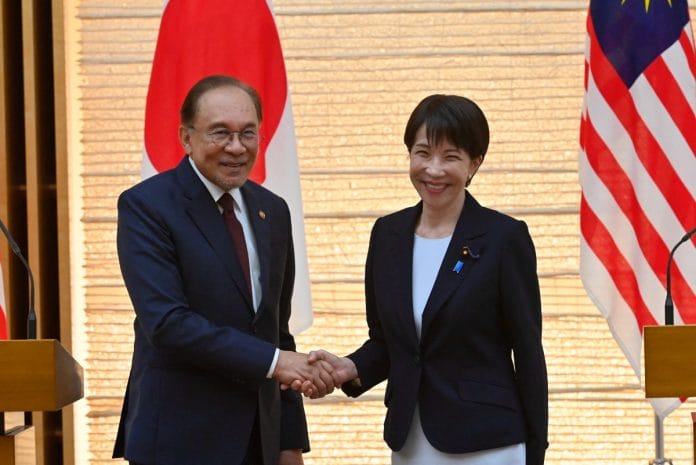
The 31st Nikkei Forum remained at a strategic juncture amid rising great-power rivalry, renewed pressure on global trade, and continuing disruptions to energy security, critical sector competition, maritime tensions in the South China Sea, and instability in the Middle East and West Asia.
For Malaysia, the visit was strategically important, designed to deepen the country’s new strategic, economic and technological engagement with Japan while simultaneously reinforcing Malaysia’s position as a rising middle power, a natural ASEAN leader and a partner of growing importance for supply-chain resilience.
This fits well with Japan’s own outlook and needs for its own economic, trade and geopolitical resilience to fill in the growing cracks and gaps. For Japan, both the Nikkei Forum and the overtures to the region provided continuing openings to consolidate ties with Southeast Asia’s key maritime, energy and manufacturing partners, aligning with Tokyo’s efforts to diversify energy supplies, strengthen maritime security cooperation, and build a credible bulwark and buffer for its security and economic needs following the energy and geopolitical crunch.
In this regard, Malaysia stands out as a credible and strategic partner.
Economic, Technological and Energy Interdependence
Economically, Japan remains a strategic partner. Japanese investment in high-value sectors- especially semiconductors, AI, the digital economy, energy transition, advanced manufacturing and resilient supply chains – has been one of the core facets of Tokyo – KL ties. Malaysia’s new economic and critical technology transition further amplifies the strategic interdependence of both nations, leveraging Malaysia’s strength in semiconductor assembly, testing and advanced packaging alongside Japan’s advantage in materials, equipment and advanced manufacturing.
This remains another strategic boost to Malaysia’s quest to move up the value chain in the semiconductor ecosystem rather than remain a low-margin production base. This is a strategic opening for transitioning toward a high technology economic set-up, escaping from the trap of extractive economy and labour intensive ecosystem.
Malaysia is seen as a stable energy supplier, providing the credible and sustainable platform for Japan to reinforce its energy security.
The new long-term LNG agreement between Petronas and Japan’s JERA was a major deliverable, cementing a much-needed institutional anchor for energy security for both sides. It strengthens Malaysia’s role in Japan’s energy security and in turn gives Malaysia a long-term commercial anchor with one of Asia’s most advanced economies.
Japan’s Strategic Objectives and Malaysia’s Regional Value
Japan’s objectives have been equally strategic and intertwined. It is now facing a strategic foreign policy dilemma of navigating both its internal and external concerns and threats, ranging from the energy crunch to hard power threats from its neighbours.
First, Tokyo wanted to secure reliable energy and critical supply chains and Southeast Asia provides more than just energy and trade routes. This completes and complements the decades old historical presence Japan already has in the region, bringing positive economic and trade spillover impact that promotes technology and knowledge transfer, spurs regional growth, advances social mobility and generates domestic growth, from Malaysia to the Philippines.
Malaysia is already an important LNG supplier to Japan, and Japan imports about 15% of its LNG from Malaysia, making Malaysia Japan’s second-largest LNG supplier after Australia, hence the growing strategic and interlinked importance.
This provides a crucial buffer for Japan, adding up over time to the country’s overall energy security.
Second, Japan wanted to deepen maritime and security cooperation with Malaysia as part of the larger equation to secure the second front in this region, which is critical for maintaining a free and open Indo Pacific and upholding the sanctity of international law. This reflects Japan’s wider Free and Open Indo-Pacific agenda, but importantly, it is pursued with Malaysia in a way that is practical and capacity-focused rather than alliance-driven, recognising the region’s pragmatic and non-aligned approach to foreign policy.
Third, Japan aimed to strengthen its relationship with ASEAN through Malaysia, as Kuala Lumpur remains among the core anchors of the region’s future growth and resilience in all domains including maritime connectivity, trade, and economic and geopolitical resilience.
Malaysia is strategically located, economically open, and central to Southeast Asian maritime connectivity, serving as the key anchor in connecting both the continental and archipelago Southeast Asia, and linking Europe and the Middle East to East Asia and the Pacific. Japan sees ASEAN as indispensable to maintaining an open regional order, resilient supply chains and economic diversification, serving as a fallback option to an increasingly parallel partner in emerging sector growth. Cooperation with Malaysia gives Japan a deeper opening to a manufacturing and energy hub, and a diplomatic bridge to the Global South and ASEAN’s broader regional architecture.
Fourth, Japan sought to deepen technology cooperation, sensing Malaysia’s emerging leadership and its natural advantages in this area, from AI to semiconductors. For Japan, Malaysia is useful not only as a production base but also as a partner in building trusted digital and industrial ecosystems in Southeast Asia.
From Conventional Partnership to Strategic Trust
All these reaffirm the path to the 70th anniversary of Malaysia-Japan diplomatic relations in 2027, advancing beyond conventional ties in traditional areas alone. The Look East Policy is no longer only about learning Japanese discipline and industrial culture; it has transcended to alignment in future-driven areas of common needs including co-creation, technology, resilience and strategic trust.
Both sides agreed to establish the Japan-Malaysia AI Platform, to strengthen critical minerals cooperation, and promote resilient energy and critical goods supply chains under Japan’s POWERR Asia initiative. The Official Security Assistance (OSA) remains the ultimate anchor in the security and defence framework, with continuous support shown in assets critical for maintaining a free and open passageway in the maritime routes, essential for both the region and to Japan.
This bolsters regional capacity and readiness to manage maritime risks, maintain situational awareness, and protect sea lanes which form the main frontlines for these regional players that depend on trade as export-oriented economies.
In that sense, Malaysia-Japan cooperation contributes to deterrence by resilience, not deterrence by provocation.
All these further reinforce trust and the decades old solid partnership. Japan sees Malaysia as a stable supplier, a pragmatic ASEAN actor and a reliable economic partner in which Japan has long had a strategic and important presence before any other Asian giants. Malaysia sees Japan as a long-term investor, technology partner, and strategic stabiliser. That trust is the real foundation of the relationship.
It also supports ASEAN centrality. Japan’s FOIP and ASEAN’s Outlook on the Indo-Pacific can therefore converge where they produce practical benefits: infrastructure, energy, maritime security, digital standards, supply-chain resilience and human capital.
Impact on Regional Economic Relations
Economically, the visit reinforces the shift from efficiency-based globalisation to resilience-based regionalisation. Fundamentals have changed, and the key question is no longer simply on finding the cheapest production, but on finding greater trust in supply chains, along with political stability and technological capability.
Malaysia will benefit because Japanese firms with their proven track record and spillover impact can help strengthen Malaysia’s move into higher-value manufacturing – particularly semiconductors, advanced packaging, medical devices, green technology and AI-enabled industries – all enhancing the thrust into a high value and high income economy based on high technology and critical sectors and no longer confined to extractive and low skilled economy.
The way forward is strategic and exciting. It aligned Malaysia’s new future driven need for high value investment, high technology, energy transition and middle-power visibility with Japan’s need for its energy security, ASEAN connectivity, maritime stability and trusted supply chains.
The new regional practicality of the power game requires practical partnerships among trusted states, with trust and track record being the ultimate factors beyond the scope of diplomatic statecraft alone.
Malaysia and Japan are now positioning their relationship as one of those partnerships – anchored in trust and solid foundational understanding at the people to people level, and increasingly relevant to Asia’s security and economic future.
COLLINS CHONG YEW KEAT Foreign Affairs, Security and Strategy Analyst Universiti Malaya


