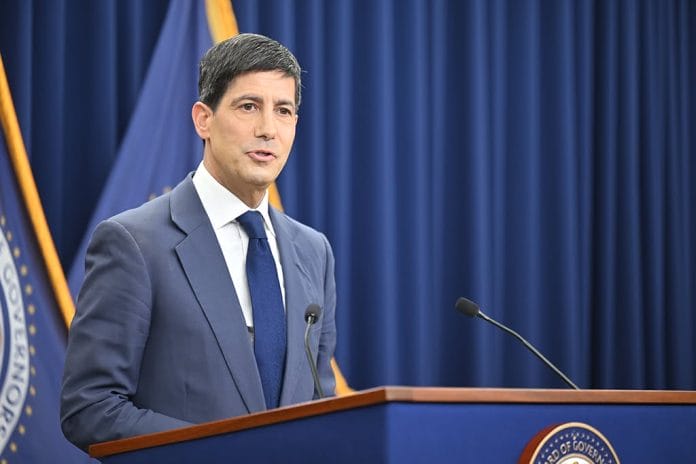
The US Federal Reserve kept its benchmark interest rate unchanged at 3.50% to 3.75% following its July 2026 Federal Open Market Committee (FOMC) meeting, in line with market expectations, although MBSB Research believes the central bank is likely to maintain a hawkish stance with the possibility of another rate hike later this year.
The decision came as three of the 12 FOMC policymakers dissented in favour of a 25-basis-point increase, underscoring lingering concerns over inflation despite signs of moderating price pressures. The dissenting members were Beth M. Hammack of the Cleveland Fed, Neel Kashkari of the Minneapolis Fed and Lorie K. Logan of the Dallas Fed.
MBSB Research said the split vote suggests the Federal Reserve remains prepared to tighten monetary policy further should inflationary risks persist.
“The latest FOMC projections and the number of policymakers favouring a rate hike indicate that another increase remains a distinct possibility in the coming meetings,” the research house said.
Economy Remains Resilient
In its policy statement, the FOMC described the US economy as continuing to expand at a “solid pace” despite heightened geopolitical uncertainty in the Middle East.
The committee also highlighted strong productivity growth and capital investment, while noting that labour market conditions remain broadly balanced.
Although US non-farm payrolls slowed to 57,000 jobs in June from 129,000 in May, marking the weakest monthly increase in four months, the unemployment rate edged lower to 4.2% from 4.3%.
MBSB said the Federal Reserve expects the labour market to remain stable, with unemployment projected to average 4.3% this year.
Inflation Still Above Target
Despite recent improvements, inflation remains well above the Fed’s 2% target.
US headline inflation eased to 3.5% year-on-year in June from 4.2% in May, marking its first decline in five months. Core inflation also moderated to 2.6% from 2.9%.
During the post-meeting press conference, Federal Reserve Chairman Kevin Warsh acknowledged that supply-side shocks, particularly higher energy prices, continue to influence inflation, with policymakers closely monitoring whether these pressures spread more broadly across goods and services.
Warsh also cautioned that the improvement in June’s inflation data has been partly overshadowed by renewed geopolitical tensions in the Middle East.
He stressed that the Fed’s latest decision should not be interpreted as a policy pause but rather as a reassessment of prevailing economic conditions and inflation risks.
Another Rate Hike Possible
MBSB expects the Fed to retain a hawkish bias, citing persistent inflationary pressures, ongoing supply chain disruptions and elevated raw material costs.
The research house believes there is scope for one additional rate hike before the end of 2026, particularly if inflation remains above target and energy prices continue to rise.
Market pricing also reflects increasing expectations of tighter policy, with implied probabilities of a rate increase standing at 62.4% for the September meeting and 89.0% for October, according to MBSB.
However, the research house noted that the likelihood of further tightening could diminish if labour market conditions weaken materially or inflation falls closer to the Fed’s 2% objective.
Geopolitics Remain Key Risk
Looking ahead, MBSB said geopolitical developments will continue to shape the inflation outlook.
A durable peace agreement between the United States and Iran could ease global oil prices and reduce energy-related inflationary pressures, potentially allowing the Federal Reserve greater flexibility in its policy decisions.
Until then, the research house expects policymakers to remain focused on containing inflation, even as economic growth and labour market conditions continue to show resilience.