


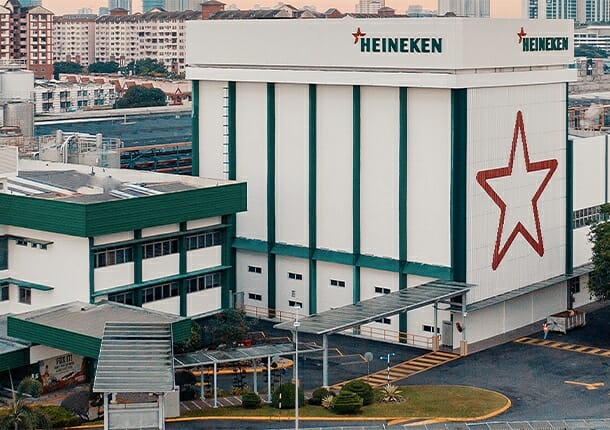
Heineken Malaysia Bhd’s second-quarter financial results came in below market expectations, prompting Hong Leong Investment Bank (HLIB) Research to lower its earnings forecasts and target price, despite maintaining a “Buy” recommendation on the brewer.
The research house said Heineken posted a core profit after tax and minority interests (PATMI) of RM48.4 million for the second quarter of FY2026, down 53.1% quarter-on-quarter and 41.7% year-on-year, bringing first-half core earnings to RM151.7 million, a decline of 26.3% from the corresponding period last year.
The results accounted for only 33% of HLIB’s full-year forecast and 32% of consensus estimates, falling short of expectations.
HLIB attributed the weaker performance primarily to subdued consumer spending and the company’s deliberate strategy to reduce ex-brewery sales initiatives, aimed at aligning distributor inventories more closely with actual market demand.
Excluding gains of RM3.3 million from property, plant and equipment disposal as well as foreign exchange gains, the research house derived first-half core earnings of RM151.7 million.
Revenue fell 34.5% quarter-on-quarter, largely due to the high base following the Chinese New Year sales season in the preceding quarter. The decline was further exacerbated by weaker ex-brewery sales.
The lower sales volume resulted in unfavourable operating leverage, with EBIT margin contracting by 7.1 percentage points, leading to the sharp drop in quarterly earnings.
On a year-on-year basis, revenue declined 19.5%, reflecting continued weak consumer sentiment alongside the group’s inventory management strategy. This translated into a 41.7% fall in quarterly profit.
For the first six months of FY2026, revenue dropped 15.7%, while core earnings declined 26.3%.
According to HLIB, management indicated that the company’s cautious approach towards ex-brewery sales will continue over the coming quarters.
Rather than aggressively pushing sales through distributor promotions, Heineken aims to ensure distributor inventories remain aligned with underlying consumer demand, a strategy expected to cap near-term sales growth.
The research house also expects the 2026 FIFA World Cup to provide only a modest boost to domestic beer sales, citing less favourable viewing hours for Malaysian audiences compared with previous tournaments.
Meanwhile, exports to Singapore are expected to increase gradually as the transition to an import-based supply model will be implemented in phases through 2027. Management did not provide guidance on the anticipated export volumes or profitability.
Following the weaker-than-expected results, HLIB reduced its earnings forecasts for FY2026, FY2027 and FY2028 by 16.5%, 8.1% and 8.0%, respectively, after factoring in lower sales assumptions.
The research house also lowered its target price to RM25.65 from RM28.07, based on a valuation of 18 times FY2027 earnings, while retaining its Buy recommendation.
Despite the near-term challenges, HLIB believes much of the weak volume outlook has already been priced into the stock, noting that brewery sector valuations are currently trading around 1.2 standard deviations below their five-year average.
Looking ahead, the research house sees upside potential from the full implementation of Asia Pacific Breweries (Singapore) Pte Ltd’s import-based supply model by the third quarter of FY2027.
HLIB estimates that if approximately 80% of Heineken Singapore’s production volume is allocated to Malaysia, it could translate into roughly 240,000 hectolitres of additional annual volume, equivalent to around 20% of Heineken Malaysia’s current domestic sales volume of approximately 1.2 million hectolitres.
The research house noted that this potential upside has yet to be incorporated into its current forecasts.


