


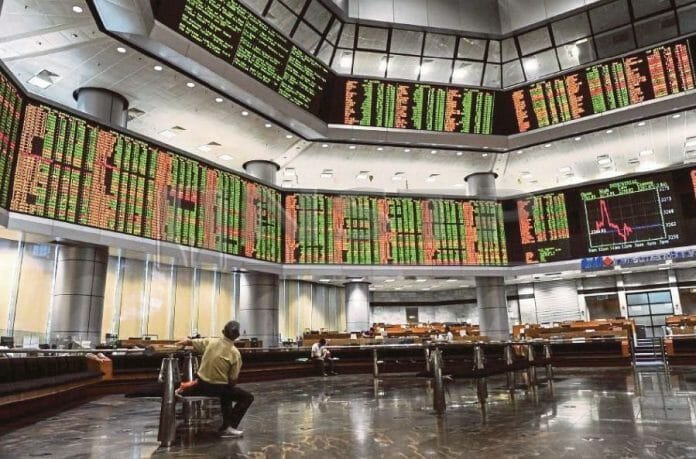
Malaysia’s equity market remained resilient in July despite a sharp sell-off in regional technology stocks, with the FBM KLCI rising 3.7% month-on-month (mom) to end the month at 1,725 points, according to CGS International.
The Malaysian benchmark outperformed the MSCI Emerging Markets Index, which fell 3.3% mom, and the MSCI All Country Asia ex-Japan Index, which declined 3.5% during the month.
CGS International said Malaysia was among the stronger-performing markets within the MIST region, comprising Malaysia, Indonesia, Singapore and Thailand, which broadly outperformed the wider Asian equity market.
Indonesia’s Jakarta Composite Index (JCI) led the MIST markets with a 10.5% monthly gain, recovering from its downward trend since the beginning of 2026.
Singapore’s Straits Times Index (STI) followed with an 8.9% gain, supported largely by a record-breaking rally in heavyweight banking stocks, while Thailand’s SET Index rose 2.0%, extending its uptrend since April.
The stronger performance across MIST markets contrasted sharply with the weakness in some major Asian technology-heavy markets.
South Korea’s KOSPI plunged 22.2% mom in July, recording one of its worst monthly performances on record as global artificial intelligence and technology stocks underwent a sharp de-rating.
The index fell nearly 34% at its intra-month low of 5,263 points, while Japan’s Nikkei also moved lower, declining about 8% mom.
CGS International noted that foreign investors returned as net buyers of Malaysian equities in July, ending two consecutive months of net selling.
However, the turnaround was modest, with net foreign inflows amounting to only RM0.3 billion.
Gross foreign selling fell 17.4% mom to RM17.3 billion, while gross buying declined by a smaller 5.3% to RM17.6 billion.
“This suggests that the turnaround in foreign flows was driven primarily by an easing in selling pressure rather than a meaningful pick-up in risk appetite,” CGS International said.
The latest inflow reduced the year-to-date net foreign selling position marginally to RM2.9 billion at the end of July.
Cumulative net foreign outflows from Malaysian equities since 2024 stood at RM29.5 billion.
Foreign ownership of Malaysian equities also edged higher to 18.4% in July, from 18.3% in June, which was the historical low.
Meanwhile, local institutional investors turned net sellers in July, recording net outflows of RM0.3 billion and ending a three-month buying streak.
Local retail investors remained net buyers, although their net inflows narrowed significantly to just RM19 million.
The broader Bursa Malaysia market also recorded widespread gains during the month, with 11 out of 13 sectorial indices ending July higher.
The plantations sector was the best performer, gaining 4.9% mom, followed by industrial production with a 4.5% gain and finance with a 3.7% increase.
At the other end of the spectrum, utilities declined 1.9%, property fell 1.4%, while REITs edged up 0.4%.
Among the 30 FBM KLCI constituents, 22 recorded share price gains during July.
Petronas Chemicals was the top-performing KLCI constituent, climbing 18.0% mom, followed by CelcomDigi with an 11.6% gain and SD Guthrie, which rose 9.9%.
The weakest performers were Axiata, which declined 5.7%, YTL Corp, down 4.9%, and IOI Properties, which fell 3.8%.
CGS International’s assessment suggests that Malaysia’s relative resilience in July was supported by the broad-based performance across key sectors and reduced foreign selling pressure, even as heightened volatility in regional technology stocks weighed on broader Asian markets.


