


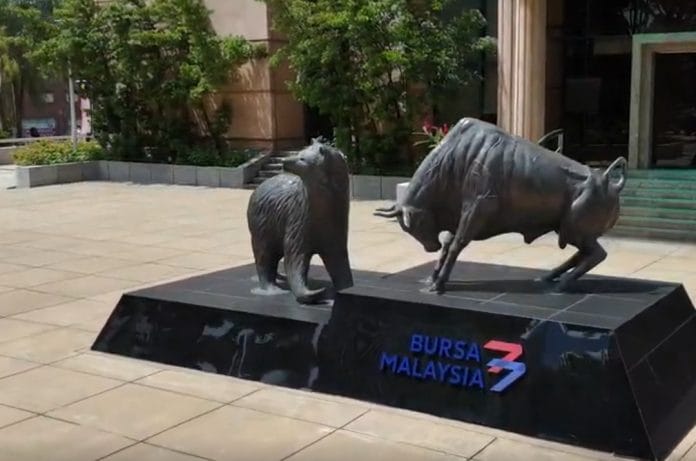
Kuala Lumpur stocks ended lower, bucking gains across most Asian markets, as persistent foreign selling, uncertainty surrounding the Strait of Hormuz and domestic political developments continued to weigh on investor sentiment.
The FTSE Bursa Malaysia KLCI (KLCI) fell 6.9 points to 1,734.7, surrendering part of its 10.2-point gain in the previous session as investors remained cautious ahead of the August corporate earnings season and expectations of stronger second-quarter economic growth.
Market breadth weakened, with 703 decliners against 410 gainers, while only eight KLCI constituents advanced compared with 19 that declined.
Selling pressure was concentrated in several major counters, including PCHEM, YTL Power, Hong Leong Bank, SD Guthrie, IHH Healthcare and Public Bank.
Foreign investors extend selling streak
Foreign institutions remained net sellers on Bursa Malaysia for a sixth consecutive trading session, recording net outflows of RM126 million.
This brought cumulative foreign selling to RM680 million over the past five trading days, RM879 million for August to date and RM3.36 billion year-to-date.
In contrast, local investors continued to provide support.
Local retailers recorded net purchases of RM112 million, while local institutions were net buyers of RM14 million.
Year-to-date, local institutions remained the strongest net buyers with cumulative inflows of RM4.0 billion, compared with net selling of RM640 million by local retailers.
Asian markets track Nasdaq rebound
Most Asian markets closed higher, taking their cue from Wall Street’s rebound as softer US inflation data eased concerns over further Federal Reserve tightening.
Technology and semiconductor counters led regional gains, supported by continued optimism over the artificial intelligence investment cycle.
Wall Street ended mostly higher, with the Dow Jones Industrial Average rising 0.13%, the S&P 500 gaining 0.66% and the Nasdaq Composite advancing 0.81%.
Softer US producer price data reinforced expectations that the Federal Reserve could leave interest rates unchanged at its 16 September meeting.
Chip stocks extended their gains, with Micron rising 4.2%, Marvell Technology gaining 3.6% and Sandisk surging 13.7%.
Renewed AI optimism was further supported by reports that Anthropic is considering an initial public offering and may acquire Decart AI for about US$6 billion.
However, HLIB Research cautioned that the rapid rebound in South Korea’s KOSPI could leave the market vulnerable to profit-taking. The index has recovered about 23% following a 22% plunge in July.
Meanwhile, unresolved US-Iran tensions, particularly uncertainty surrounding the reopening of the Strait of Hormuz, and elevated oil prices remain key sources of market volatility.
Investor sentiment was also restrained by the lack of concrete easing measures from China’s central bank, reinforcing expectations that broad-based monetary stimulus is unlikely to provide an immediate boost to China’s struggling economy.
Oil prices retreat
Brent crude fell to around US$87 a barrel after five consecutive sessions of gains as investors refocused on weakening demand prospects.
However, stalled diplomatic efforts to end the Iran conflict and restore normal shipping through the Strait of Hormuz continued to cloud the outlook for energy markets.
For Malaysia, prolonged uncertainty over the strategic shipping route remains a key risk given its potential impact on energy prices, inflation and investor sentiment.
KLCI remains in sideways consolidation
From a technical perspective, HLIB said the KLCI remains in an uptrend despite its recent consolidation.
The index had rallied about 95 points from its year-to-date low of 1,655 on June 29 to 1,750 on August 6, before moving sideways and closing at 1,734.7.
The broader uptrend remains intact, with the index holding above its descending channel and key moving averages.
HLIB identified 1,750 as the immediate resistance level. A decisive breakout above this level could pave the way towards 1,762, corresponding to the weekly upper Bollinger Band, followed by the year-to-date high of 1,771.
On the downside, a break below 1,720, which represents the downtrend line, could trigger a deeper correction towards 1,700.
HLIB expects the KLCI to remain range-bound as investors reassess their positioning amid external and domestic uncertainties and a lack of fresh catalysts.
The research house said doubts over a swift US-Iran agreement to reopen the Strait of Hormuz, the upcoming August earnings season and renewed foreign outflows are likely to keep market sentiment cautious.
Political developments in focus
Domestically, investors are also keeping a close watch on political developments following Barisan Nasional’s landslide victory in Johor and its strong showing alongside Perikatan Nasional in the Negeri Sembilan polls.
Attention is now turning to the DAP Conference on August 16, where the party is expected to decide whether to remain in the federal government.
Investors are also likely to monitor the potential timing of elections in Melaka, whose current term is due to end in December 2026, and Sarawak, where the term is due to expire in February 2027.
Beyond the state elections, market participants will increasingly focus on the timing of the 16th General Election, with the current federal term due to end in December 2027.
HLIB said closer cooperation between Barisan Nasional and Perikatan Nasional at the state level could potentially pave the way for broader political alignment nationally, adding another factor for investors to consider as they position themselves for the months ahead.


