


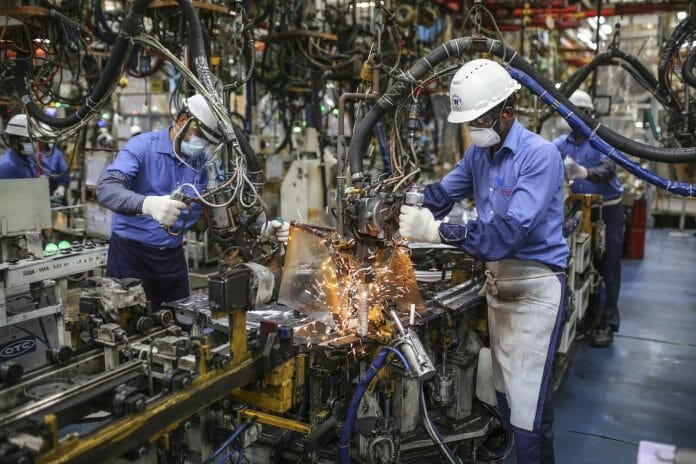
Japan’s manufacturing sector expanded at a faster pace in August, with new orders recording their strongest growth in more than eight years, according to the latest S&P Global flash PMI survey.
The S&P Global Flash Japan Manufacturing Purchasing Managers’ Index (PMI) rose to 55.1 in August from 54.5 in July, remaining comfortably above the 50-point threshold that separates expansion from contraction.
The latest reading points to a strengthening manufacturing sector despite Japan’s economy slowing in the second quarter.
“While we saw growth momentum pick up across both manufacturing and service sectors, factories continued to lead growth, registering sharp increases in both production and new orders,” said Annabel Fiddes, economics associate director at S&P Global Market Intelligence.
Manufacturers recorded their fastest increase in new orders since January 2018, while total sales and overseas demand also posted their steepest increases in more than 8-1/2 years.
Fiddes said manufacturers were benefiting from strong demand from the semiconductor and artificial intelligence-related industries, supporting a broader improvement in factory activity.
Manufacturing firms also led employment growth during the month and increased their purchases of inputs. However, stocks of purchases rose only slightly while supplier delivery times lengthened markedly, suggesting some pressure within supply chains as activity strengthened.
The services sector also gained momentum in August. The S&P Global Flash Japan Services PMI Business Activity Index increased to 52.3 from 51.2, while the Composite Output Index rose to 53.4 from 52.7, marking its highest level since February.
Cost pressures meanwhile eased from June’s near-record pace, with overall input inflation across Japan’s private sector slowing to a five-month low.
Despite the moderation in input costs, selling prices for goods and services continued to rise at one of their steepest rates on record, indicating that price pressures have not fully disappeared.
Business confidence also improved to its highest level since February, with manufacturers showing greater optimism than services companies. Firms cited expectations of higher sales, increased operational capacity and stronger overall market conditions.
The upbeat private-sector data comes after Japan’s economy slowed in the second quarter, according to GDP figures released earlier this week. Investors largely brushed aside the weaker growth figure, viewing it as reflecting one-off factors.
Fiddes said the latest PMI data added to hopes that Japan’s private sector remained well positioned to perform strongly, provided there were no further shocks to prices or demand.
Reuters


