


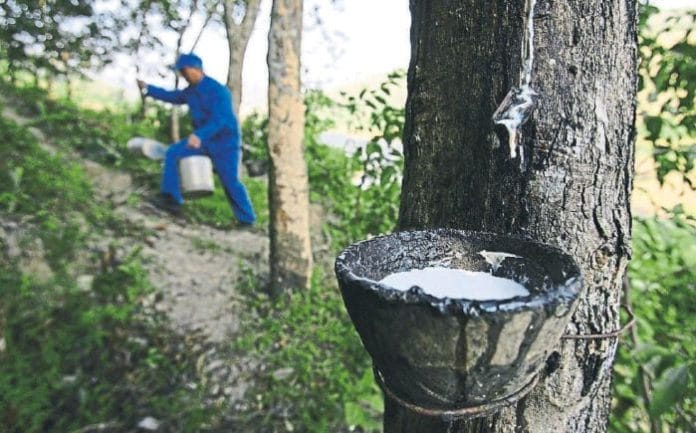
Malaysia’s natural rubber (NR) production increased 1.0% month-on-month to 26,817 tonnes in July 2026, although output remained sharply lower compared with a year earlier, according to the Department of Statistics Malaysia (DOSM).
Production rose from 26,553 tonnes in June but was 25.3% lower year-on-year compared with 35,884 tonnes recorded in July 2025.
Smallholders continued to dominate domestic production, accounting for 87.6% of total output, while estates contributed the remaining 12.4%.
Malaysia’s natural rubber stocks, meanwhile, declined 0.7% to 128,946 tonnes from 129,836 tonnes in June. Rubber processing factories held 77.8% of inventories, followed by rubber consumer factories at 22.0% and estates at 0.2%.
Natural rubber exports increased 6.2% month-on-month to 41,241 tonnes in July, from 38,821 tonnes previously.
China remained Malaysia’s largest export destination, absorbing 45.2% of total natural rubber exports, followed by Germany at 14.4%, the United States at 9.1%, the United Arab Emirates at 6.4% and Brazil at 3.3%.
Malaysia’s rubber-based product exports were supported by rubber gloves, with export value rising to RM1.7 billion in July, up 20.4% from RM1.4 billion in June.
Despite the improvement in exports, rubber prices softened during the month.
The average price of concentrated latex slipped 1.5% to RM7.25 per kilogramme from RM7.36 in June, while scrap rubber declined 5.0% to 753.23 sen per kilogramme from 792.76 sen.
Citing World Bank commodity price data, DOSM said the price of Technically Specified Rubber 20 (TSR 20) fell 4.9% to US$2.14 per kilogramme in July from US$2.25 in June.
The Singapore/Malaysia rubber price similarly declined 2.8% to US$2.78 per kilogramme, from US$2.86 previously.


