


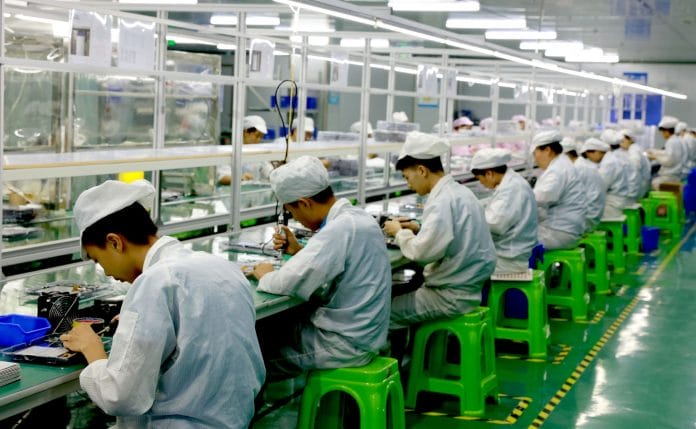
China’s value-added industrial output increased 5.3% year-on-year in the first eight months of 2026, as factory activity remained one of the stronger parts of the economy despite persistent weakness in domestic consumption and investment.
Industrial output from enterprises above the designated size rose 5.2% year-on-year in August, accelerating from 4.5% in July and exceeding market expectations of around 4.8%, according to data from the National Bureau of Statistics.
The January-August growth rate was unchanged from the 5.3% expansion recorded in the first seven months, when manufacturing output rose 5.6%, equipment manufacturing expanded 9.7% and high-tech manufacturing surged 13.8%.
The latest figures point to continued resilience in China’s manufacturing sector, which has increasingly relied on advanced manufacturing, technology-related production and exports to support economic activity.
However, the strength in industrial production contrasts with continued weakness elsewhere in the economy.
China’s fixed-asset investment fell 7.2% year-on-year in the first eight months, worsening from a 6.7% decline in the January-July period, while retail sales rose only 0.4% year-on-year in August, down from 0.6% in July.
The property sector also remains a significant drag, with real estate investment falling sharply during the period and home prices remaining under pressure. New home prices declined 0.1% month-on-month in August and were 3.0% lower from a year earlier.
Weak credit demand has added to concerns over the strength of domestic activity. Chinese banks issued just 60 billion yuan in new loans in August, well below market expectations, while household borrowing contracted for a sixth consecutive month.
The contrasting indicators underline the increasingly uneven nature of China’s recovery, with manufacturing and industrial output outperforming consumer spending, property and investment.
Beijing is expected to continue relying on fiscal support, infrastructure investment and measures to stimulate consumption as it seeks to sustain economic momentum through the remainder of 2026.


