


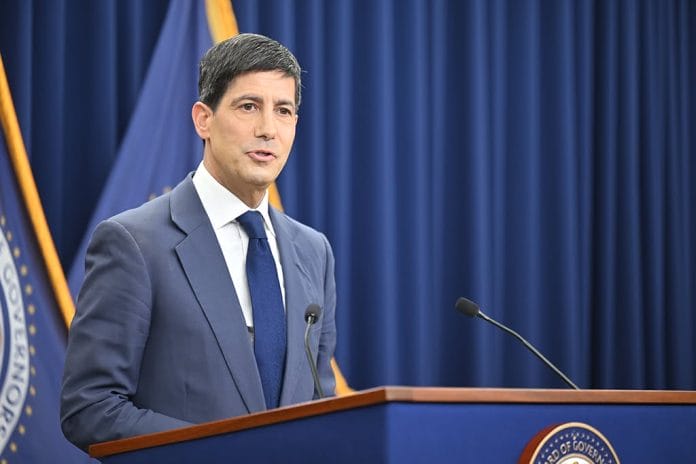
Standard Chartered expects the US Federal Reserve to raise interest rates twice more by June 2027 following its latest policy tightening, as resilient economic growth, strong artificial intelligence (AI) investment and persistent inflation keep pressure on the central bank to maintain a restrictive monetary stance.
In his market commentary, Standard Chartered’s Rajat Bhattacharya said the Fed’s unanimous decision to increase rates this week, its first hike since 2023, reinforced the bank’s expectations of a more hawkish policy direction.
The Fed also signalled another increase by December, while the Bank of Japan (BoJ) raised rates during the same week.
Standard Chartered noted that the Fed, European Central Bank and BoJ had all increased rates within the same month, reflecting concerns over renewed energy-driven inflation and tight labour markets.
Fed Rates Seen Reaching 4.5% By Mid-2027
Standard Chartered forecasts another 25-basis-point Fed hike by the end of 2026, bringing the federal funds rate to 4.0%–4.25%, followed by a further increase in the first half of 2027 to 4.25%–4.5%.
Bhattacharya attributed the Fed’s policy shift to stronger US job creation, persistent inflation and the rebound in oil prices following renewed tensions in the Middle East.
However, the bank’s projected tightening path remains less aggressive than money-market expectations of three additional rate increases by June 2027.
Standard Chartered expects inflationary pressures to ease from the second quarter of 2027 as the effects of higher oil prices and tariffs diminish.
It believes this could create room for interest rate cuts in the second half of 2027, potentially bringing the Fed’s policy rate back to 4.0%–4.25% by year-end.
US Treasury Yield Forecasts Revised Higher
Reflecting its revised interest rate expectations, Standard Chartered has raised its US government bond yield forecasts.
The bank now expects the benchmark 10-year US Treasury yield to reach 5.0%–5.25% over the next three months, while its 12-month forecast has been revised to 4.75%–5.0%.
Higher bond yields could weigh on equity valuations in the near term, although Standard Chartered believes improving clarity over the Fed’s policy direction should help investors reassess opportunities based on corporate earnings.
The bank estimates that a 25-basis-point increase in US interest rates could reduce the valuation of the S&P 500 and global equities by approximately 3%–4%.
Nevertheless, it expects stronger corporate earnings to offset some of the pressure from higher borrowing costs and discount rates.
AI And Semiconductor Stocks Remain In Focus
Standard Chartered sees opportunities to increase equity exposure during market pullbacks, arguing that interest rate increases do not necessarily undermine medium-term equity performance when accompanied by strong earnings growth.
Bhattacharya said concerns over a potential slowdown in AI development among leading technology companies appeared excessive.
The bank consequently maintained its preference for diversified exposure to large-cap technology and semiconductor companies, supported by continued AI investment and earnings expansion.
It also believes markets have already incorporated much of the Fed’s more hawkish stance into asset prices.
BoJ Raises Rates, BoE Holds Steady
In Asia, the BoJ increased its policy rate by 25 basis points to 1.25%, its highest level in three decades.
However, the central bank’s 7–2 voting split contributed to renewed yen weakness amid uncertainty over the pace of further tightening.
Standard Chartered remains constructive on the Japanese currency, expecting the BoJ to potentially raise rates by 25 basis points each quarter until the second quarter of 2027 as domestic wage-driven inflation persists.
Meanwhile, the Bank of England maintained interest rates as weakness in the UK labour and housing markets offset renewed energy-related inflation pressures.
Standard Chartered expects the BoE to deliver fewer increases than the 100 basis points currently reflected in market pricing, potentially keeping the pound trading within a relatively narrow range.
Overall, the bank expects global monetary policy to remain restrictive in the near term but sees room for financial markets to stabilise as inflation moderates and uncertainty over the direction of interest rates diminishes.


