



By Ph. Kek Jin Er (Laura) Pharmacist, Community & Primary Care Strategist
When the haze rolls in, a familiar scene plays out in every Malaysian household: Someone digs out a box of N95 or KN95 masks, hands them around, and everyone heads out the door assuming the job is done.
But a respirator like this isn’t really a “put it on and forget it” tool. Worn the wrong way, it protects far less than most of us assume. And for a few groups e.g. pregnant women and children especially, it may not even be the right tool to reach for.
Let’s clear up what actually matters.
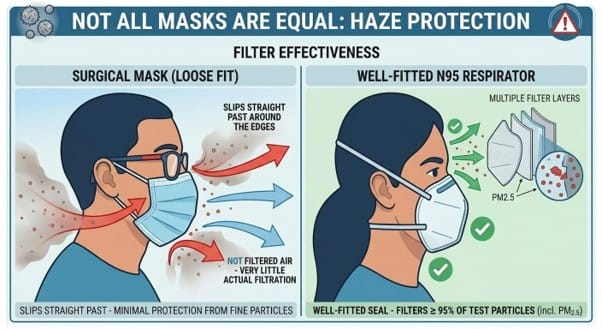
Haze is made up of very fine particles, small enough to slip straight past a loose surgical mask. A properly fitted N95 is designed to filter at least 95% of test particles around the size that is hardest for the filter to capture, which means it can substantially reduce exposure to fine haze particles, including PM2.5. That’s exactly why health authorities point to a well-fitted respirator over and ordinary surgical mask when the air outside turns hazy.
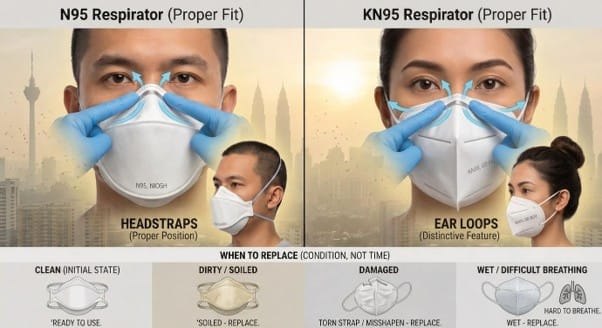
KN95 respirators are manufactured to China’s GB 2626 standard and are designed to achieve at least 95% particle-filtration efficiency under specified test conditions. A genuine, compliant KN95 may be a reasonable alternative, but performance also depends heavily on fit. Many KN95 models use ear loops, which may not seal as reliably as the two headbands commonly used by N95 respirators.
“Well-fitted” is the key word here. A respirator only protects YOU as well as its seal.
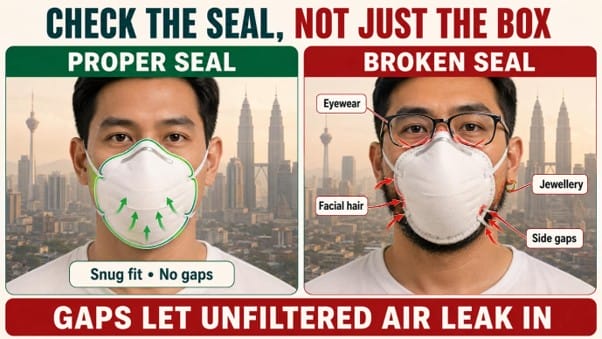
The mask should sit snugly across the nose, cheeks and chin, with no gaps for air to sneak in around the edges, true for both N95 and KN95.
Here’s the part that catches a lot of people out: facial hair, jewellery or eyewear sitting under the sealing edge can break that seal and let unfiltered air leak straight in. If there’s a gap anywhere, the respirator underneath it is doing a lot less than you’d hope.
This is where a lot of misinformation floats around. Some claims that an N95 or KN95 is “only safe for one hour,” or that outdoor trips must be capped at exactly 30 to 40 minutes. There is no universal time limit. How long a respirator can be worn comfortably depends on the wearer, activity level, environmental conditions and fit. If it becomes uncomfortable or difficult to breathe through, move to cleaner indoor air and remove it safely.
What’s actually useful to know instead: replace the respirator when its condition changes, when it becomes wet, dirty, damaged, misshapen, hard to breathe through, or no longer seals properly.
Never wash, heat or attempt to disinfect a disposable N95 or KN95 at home; these methods may damage the respirator, affect its filtration performance, or reduce its ability to seal properly.
If the mask starts to feel uncomfortable, the right move is to head indoors to cleaner air before taking it off, not to pull it down in the middle of a smoky street.
One more myth worth putting to rest: wearing a well-sealed respirator does increase the effort of breathing, and some people do feel discomfort, tiredness or a mild headache because of that added resistance.
Although respirators can increase breathing effort and discomfort, current evidence does not support the claim that normal use causes dangerous CO2 poisoning in healthy adults.
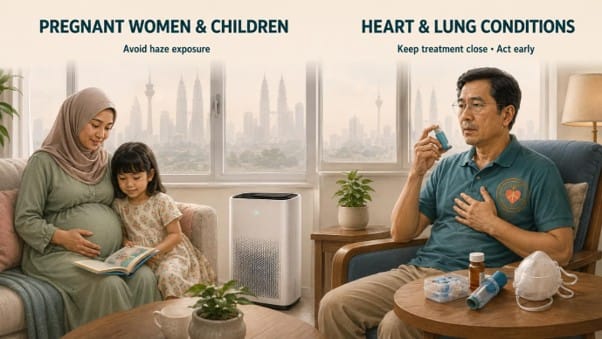
According to Ministry of Health Malaysia haze guidance, N95 respirators are considered suitable for pregnant women. Since other tight-fitting respirators such as KN95 may also increase breathing effort, pregnant women should prioritise avoiding haze exposure and consult their doctor before using one.
For pregnant women, the priority isn’t really “which mask”, it’s “how to avoid needing one” in the first place.
That means staying indoors with cleaner air, and skipping outdoor trips that aren’t necessary while the haze is heavy. If getting outdoors genuinely can’t be avoided, the safest bet is to check with your doctor about what suits your own circumstances. MOH guidance also states that N95 respirators are unsuitable for children, an adult-sized respirator may not seal properly on a child’s face, so keeping children indoors during heavy haze matters just as much.
If you’re managing asthma, COPD, or a heart or lung condition, haze season calls for a bit of a strategy shift too:
Reduce outdoor exposure first. Keep doors and windows closed when appropriate and use an air purifier indoors if you have one.
Keep your treatment close by. Continue medication as prescribed, carry a reliever inhaler if one has been prescribed, and follow your asthma action plan if you have one.
Respond early to warning signs. If wheezing, dizziness, chest tightness or unusual shortness of breath develops, move immediately to cleaner indoor air and remove the respirator once safe. Seek urgent medical attention if symptoms are severe, worsening, or do not improve.
Myth Vs Fact: N95/KN95 During Haze
Myth Fact You can only wear an N95 or KN95 safely for one hour. There’s no fixed time limit. Replace it based on its condition: wet, damaged, dirty or hard to breathe through. N95/KN95 masks cause dangerous CO2 buildup. They increase breathing effort and can cause discomfort in some people, but current evidence does not support the claim that normal use causes dangerous CO2 buildup in healthy adults. N95 is the safest option for everyone, including pregnant women. MOH guidance does not consider the N95 suitable for pregnant women, and other tight-fitting respirators such as KN95 may carry the same concern. Staying indoors and consulting a doctor is the priority instead.
Quick Recap For Haze Season
- Check the seal every time: facial hair, jewellery, eyewear and gaps reduce protection.
- Replace by condition, not by the clock and never wash, heat or disinfect an N95 or KN95 at home.
- If it becomes uncomfortable, move to clean indoor air before removing it.
- Pregnant women and children: staying indoors comes first; speak to your doctor if outdoor exposure can’t be avoided.
- Asthma, COPD, heart or lung conditions: keep your medication and action plan ready, and respond early, don’t wait out severe symptoms.


