



Honda and Nissan announced that timeline has been set for the leading automakers to merge by 2026, potentially creating the world’s fourth-largest auto group by vehicle sales after Toyota, Volkswagen and Hyundai (based on Jan-Sep 2024 vehicle sales data by Felipe Munoz), reported Reuters on Dec 23.
Honda and Nissan are expected to list the holding company shares in August 2026. Both companies are aiming to wrap up talks around June 2025 before setting up a holding company by August 2026, when shares of both Honda and Nissan would be delisted.
Smaller Mitsubishi Motors, in which Nissan is top shareholder, was also considering joining and would make a decision by the end of January, the companies said.
Combining with Mitsubishi Motors, the global sales of the merged company would amount to ore than 8 million cars.
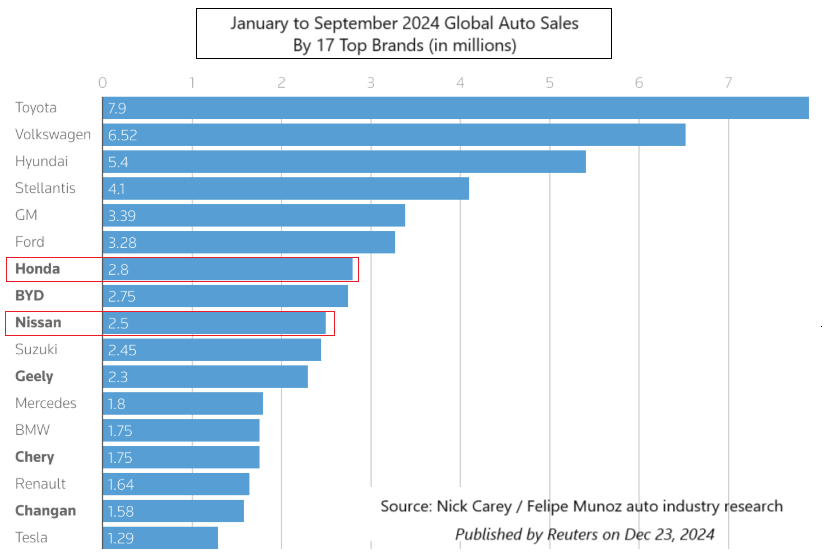
The merger of Honda, Japan’s second-largest automaker, with Nissan, the third-largest, would be the biggest reshuffling in the global auto industry since Fiat Chrysler Automobiles and PSA merged in 2021 to create Stellantis in a US$52-billion deal.
“The rise of Chinese automakers and new players has changed the car industry quite a lot,” said Honda CEO Toshihiro Mibe in a press conference held in Tokyo, referring to technological trends of electrification and autonomous driving especially the self-driving vehicles.
The Honda chief said automakers must build up their capabilities to fight emerging automakers and embrace automotive technological surge by 2030 or face defeat.
The merged companies would aim for combined sales of 30 trillion yen (about US$191 billion or RM857 billion) and operating profit of more than 3 trillion yen (about US$19 billion or RM86 billion).
Honda, which has a market capitalisation of more than US$40 billion, roughly four times that of Nissan, will appoint the majority of the company’s board, they said.
Last month, Nissan announced a plan to cut 9,000 jobs and 20% of its global production capacity after sales plunged in the key China and US markets.
Honda also reported worse-than-expected earnings due to a China sales slump, although solid motorcycle and hybrid car businesses helped it secure a relatively stable financial base.


