A new national report reveals significant gaps in Malaysia’s progress on disability rights, particularly for women and individuals assigned female at birth (AFAB). Despite the country’s commitments under the Sustainable Development Goals (SDGs) and the United Nations Convention on the Rights of Persons with Disabilities (CRPD), many continue to face barriers accessing sexual and reproductive health services, education, and public facilities.
The report, “National Report on Monitoring the SDGs at 10 Years: Sexual and Reproductive Health and the Lived Experiences of Women and Individuals Assigned Female at Birth with Disabilities in Malaysia,” was launched on July 30 at Mereka Space, Kuala Lumpur.
The findings document how women with disabilities continue to face immense barriers in healthcare, education, employment, and access to safe public spaces. One participant summed up the frustration: “They ask us to be independent, but they forget that independence is not given—it is enabled.”
The publication is the product of a collaborative effort between the Datum Initiative, ARROW (Asian-Pacific Resource and Research Centre for Women), and the Southeast Asia Research Centre for Digital Tech and Society at Monash University Malaysia.
The report is part of a wider regional initiative and focuses on giving voice to those too often left out of national conversations—women whose needs are frequently sidelined in policy and planning.
At the report’s launch, Dr Vilashini Somiah, co-founder of the Datum Initiative and a senior lecturer at Universiti Malaya’s Gender Studies Programme, emphasised the power of data in driving change.
“When gathered and handled with care, data becomes a collective force for structural change,” she said. “This report is grounded in care, stitched together with the voices of persons with disabilities who spoke bravely and honestly about their experiences of medical neglect, institutional abandonment, and everyday resilience.”
The research team—Dr Benjamin Y.H. Loh, Dr Vilashini Somiah, Hasbeemasputra Abu Bakar, and Dr Nadirah Babji—combine expertise in digital ethnography, feminist anthropology, disability rights, and public health to paint a sobering picture of progress.
While Malaysia has made strides on paper since ratifying the CRPD in 2010, lived experience tells a different story. An estimated 16% of Malaysia’s population are persons with disabilities, yet many remain blocked from full participation in society, lacking equal access to justice, education, healthcare, digital tools, and social inclusion.
The report features testimonies that reveal how systemic neglect continues to limit disabled women’s access to basic services. “It’s not a disability when I’m unable to hear through my ear,” noted Hasbeemasputra, a co-researcher and disability rights advocate.
“It becomes a disability only when I am not permitted access to hearing aids so I may be able to hear.” His words highlight how disability is often created—or worsened—by societal barriers, not physical conditions alone.
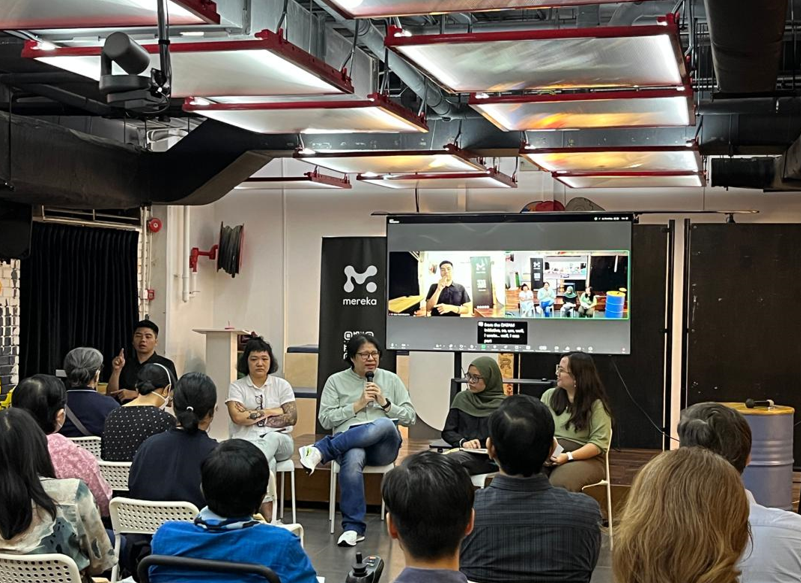
One of the key themes at the event was digital inclusion. A panel discussion explored how disabled individuals, frequently excluded from traditional systems, have turned to technology to find empowerment, community, and access. Panellists included economist and Boleh Space representative Adhura Farouk, filmmaker and AIDA founder Beatrice Leong, and Dr Benjamin Loh from Monash University Malaysia, moderated by Dr Farhana Binti Abdul Fatah of Universiti Malaya.
Highlighting the report launch was a panel discussion titled “Digital Inclusion and Women with Disabilities,” where advocates and researchers explored how technology can become a bridge rather than a barrier.
Adhura Farouk, a disabled economist with Boleh Space, made a compelling point: “I like to use the term ‘pre-disabled’. Because the truth is, every single one of us carries the risk of becoming disabled one day. Disability is not something that happens to ‘other people’; it is a shared human vulnerability. When we start from that understanding, inclusion stops being charity and becomes justice.”