



Global data infrastructure company NetApp believes that ASEAN is entering a decisive phase in its push into artificial intelligence (AI) and digital infrastructure, where success will depend less on headline-grabbing AI models and more on getting data foundations, security and cost discipline right.
NetApp area vice president and general manager for Greater China, ASEAN and South Korea Henry Kho (centre in pic) told BusinessToday Malaysia that, as governments and enterprises across the region step up investment in AI and cloud, the focus is shifting to where data lives, how it is protected and how it can be used across increasingly complex hybrid and multi-cloud environments.
He cited Malaysia’s recent RM2 billion push into sovereign AI cloud initiatives as an example of how policy and enterprise priorities are starting to converge around data, infrastructure and control.
“There is a lot of growth potential and a lot of greenfield opportunities for us to help customers make sense of AI and what they should prioritise,” said Kho, adding that the region remains one of the company’s key growth engines, with large greenfield opportunities as organisations move from experimentation to execution in AI.
“We are working very closely with our partner ecosystem because we need to combine our capabilities with our partners’ domain expertise to help customers move from ideas to implementation.”
Kho explained that the investment being made by governments across ASEAN showed a clear ambition to build AI-ready economies. In Malaysia, he noted, the sovereign AI cloud push reflects a broader goal to become a high-income, AI-ready nation, a direction that can be seen across the region.
At the enterprise level, early AI adoption has been driven largely by productivity gains.
NetApp director and APAC head of AI sales and go-to-market Elaine Chan (right in pic) said that many organisations have started with tools such as Microsoft Copilot, while others are applying AI in areas such as manufacturing quality control and automotive development.
“Customers are looking at AI first to improve productivity, and that’s where data becomes critical,” she said. “You can build good models, but they are only useful if you have the right data to train and run them.”
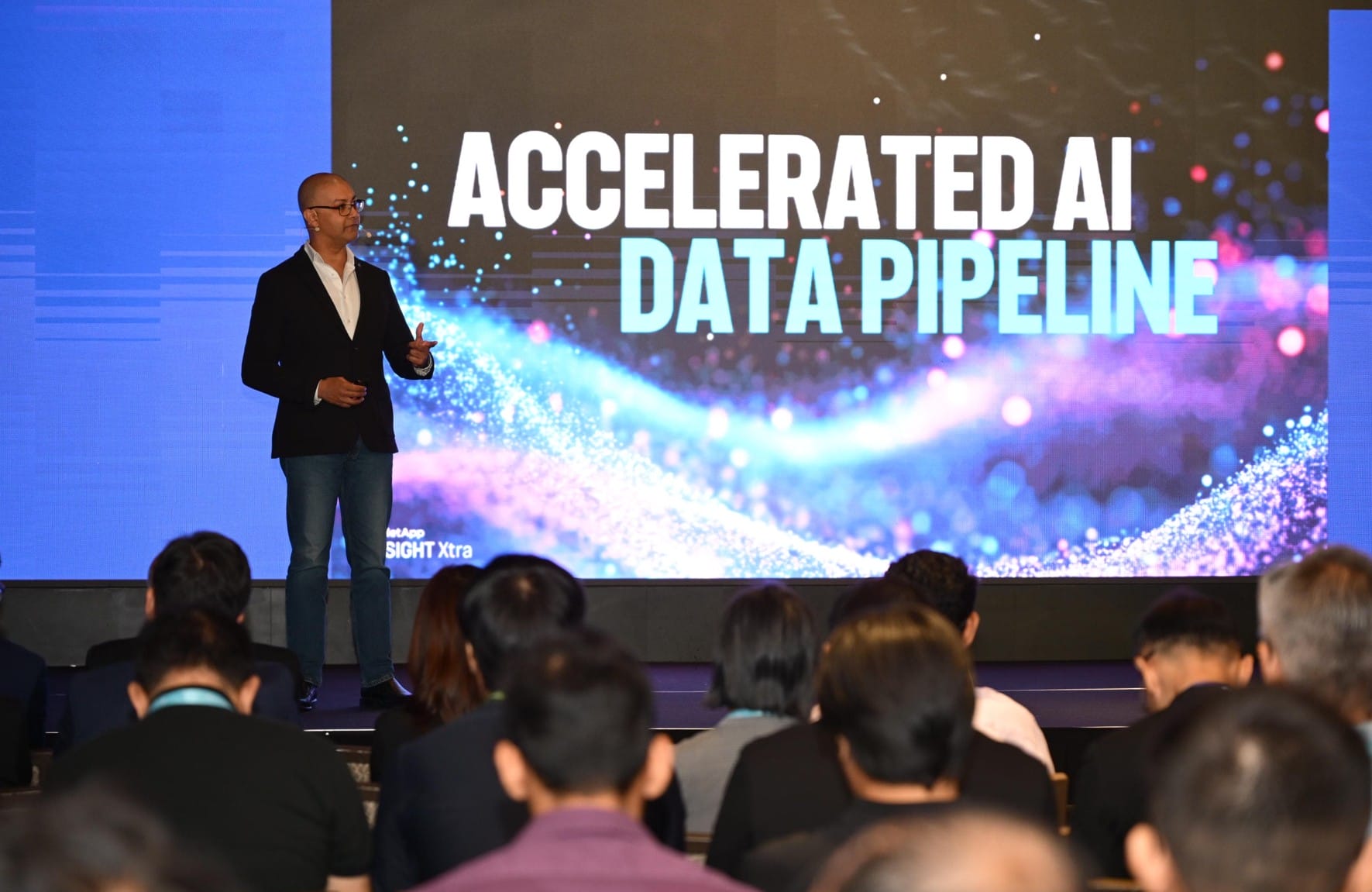
These views were shared at NetApp’s inaugural regional customer conference, INSIGHT Xtra Singapore 2026, where the company outlined its strategy around AI, cloud and data infrastructure for the Asia Pacific market.
One issue that now features in almost every customer discussion is data sovereignty and security.
NetApp chief technical officer for APAC and Japan Dhruv Dhumatkar (left in main pic) said that more countries in the region are tightening expectations around where data should reside and how it should be protected.
“As a consequence, there is a growing focus on cybersecurity,” he said. “Almost every conversation with customers involves their security posture and how their data is protected.”
Chan added many countries are now looking at sovereign AI, where data stays within national borders and organisations develop their own models that reflect local languages and cultures.
“From our perspective, we can help customers manage data sovereignty through our multi-tenancy capabilities, especially for new cloud providers building data centres in these countries,” she said.
“That allows them to serve local enterprises, protect data and build their own models for training.”
At the same time, the sheer volume of data is rising fast. Dhumatkar said technologies such as the Internet of Things, 5G and richer edge telemetry are driving a surge in both the amount of data being created and the number of places it comes from.
“Higher quality images, drones and better bandwidth all mean more data from more sources,” he said. “That creates real challenges when organisations are trying to improve productivity and competitiveness while managing this growing complexity.”
This is where NetApp’s roots in data storage and management come into play.
“Beyond storing data and keeping it safe, secure and scalable, we have to help customers build more value around how that data is managed and used,” said Kho.
The company sees four main imperatives for customers in the region. These are modernising IT assets, accelerating cloud adoption, enabling AI and strengthening cyber resilience.
Towards this end, NetApp has rolled out a series of innovations across these areas, including its AFX disaggregated architecture for large-scale environments, the Data Engine for understanding and locating information, tighter integration between on-premise and cloud environments and tools for breach detection and isolated recovery.
Cybersecurity is also a priority for NetApp itself given that its software underpins critical infrastructure for many organisations and hyperscale cloud providers. The company’s approach focuses on protecting data where it sits and using machine learning to detect abnormal behaviour before attacks cause damage.
Chan said NetApp’s broader aim is to act as a unifying data platform across on-premise, cloud and multi-cloud environments, with security built in rather than bolted on.
“We provide a single data foundation across where your data sits, and we have inbuilt security capabilities including AI-powered ransomware protection,” she said. “Trust and governance matter because organisations need to know their data is being used for the right purpose. Once you have that visibility, you can build better use cases and get better returns from your AI investments.”
Another key challenge for enterprises is balancing cost, performance and sustainability. Kho explained that not all workloads belong in the cloud and organisations are increasingly making careful trade-offs based on economics and performance needs.
“For less performance-critical workloads, customers can use disk-based systems that are more cost effective,” he said. “For mission-critical, high-performance workloads, we have AFX that can scale in a disaggregated way. Our ONTAP operating system runs across the whole portfolio and into multiple clouds, which gives customers flexibility.”
Kho said NetApp’s view is that AI is ultimately a data problem rather than a race to build the biggest GPU farms. “Our focus is on helping customers manage data more effectively and more efficiently in a smaller footprint, while balancing performance and sustainability,” he said.
As ASEAN accelerates its AI and digital ambitions, NetApp’s message is that the real work lies in building resilient, sovereign and efficient data foundations that can support growth over the long term.


