


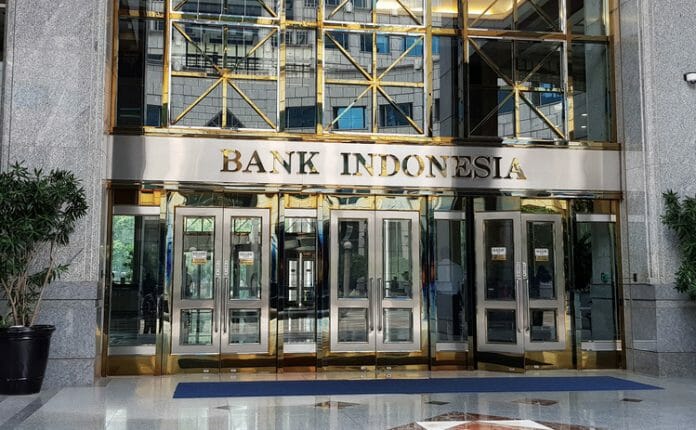
Bank Indonesia (BI) has maintained its benchmark policy rate at 4.75% for the sixth consecutive month, as the central bank prioritises rupiah stability amid rising global uncertainty linked to the prolonged Middle East conflict.
The decision, made at BI’s fourth Board of Governors meeting of 2026, was in line with market expectations and Kenanga Investment Bank’s forecast.
The central bank also left its Deposit Facility Rate unchanged at 3.75% and its Lending Facility Rate at 5.50%.
In its policy statement, BI said the decision was aimed at strengthening the rupiah while ensuring inflation remains within its 2026–2027 target range of 1.5% to 3.5%.
It also reiterated its readiness to tighten monetary policy further if needed, while continuing accommodative macroprudential and payment system policies to support economic growth.
Kenanga said BI has now firmly shifted into “hold mode” as external risks intensify, particularly from geopolitical tensions involving the Middle East conflict.
“Higher oil prices, shipping disruptions, rising US Treasury yields, and sustained US dollar strength are reinforcing external stability risks for Indonesia,” the research house said.
It added that BI has become more cautious in its global outlook, cutting its 2026 global growth forecast to 3.0% from 3.1%, while raising its global inflation forecast to 4.2% from 4.1%.
The central bank also expects US Federal Reserve rate cuts to be delayed and possibly pushed to the end of 2026, further limiting room for policy easing.
As a result, Kenanga believes the window for BI rate cuts has effectively closed in the near term, with monetary policy likely to remain on hold and tilted toward foreign exchange defence.
Support for growth is instead expected to come from macroprudential easing, liquidity measures, and closer fiscal-monetary coordination.
Despite the challenging external environment, BI maintained its 2026 GDP growth forecast at 4.9% to 5.7%, supported by resilient domestic demand.
First-quarter growth was driven by stronger household spending, higher government expenditure, and sustained investment activity, particularly in construction linked to priority government projects.
BI stressed the importance of maintaining growth momentum amid global disruptions.
On inflation, Indonesia’s March headline inflation eased sharply to 3.48% from 4.76% in February.
However, BI warned of upside risks from rising global oil and commodity prices caused by the Middle East conflict.
Still, inflation is expected to remain within the target band over 2026 and 2027, supported by close coordination between the central bank and the government.
The rupiah remains under pressure, weakening 2.7% year-to-date to 17,138 against the US dollar as of April 21 and hovering near its record low of 17,158.
Kenanga noted that the rupiah has underperformed regional peers such as the Thai baht, which fell 2.1%, and the Philippine peso, down 1.8%, while the Malaysian ringgit bucked the trend by strengthening 2.6%.
The research house maintained its year-end forecast for the USD/IDR exchange rate at 16,480, although it flagged downside risks to the rupiah outlook due to prolonged geopolitical tensions, elevated oil prices, delayed Fed easing and persistent global risk aversion.
Nevertheless, BI’s aggressive intervention strategy is expected to help prevent disorderly depreciation of the Indonesian currency.


