


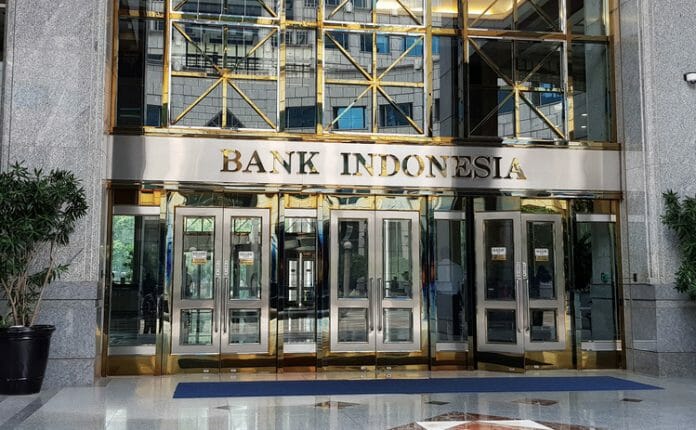
Bank Indonesia (BI) kept its benchmark policy rate unchanged at 5.75% at its August meeting, in line with market expectations, as the central bank continued to prioritise Rupiah stability amid heightened global volatility and ongoing geopolitical tensions in the Middle East.
According to Kenanga Research, BI also maintained its deposit facility rate at 4.75% and lending facility rate at 6.50%.
BI said the current policy rate remained consistent with efforts to strengthen Rupiah stability, maintain inflation within its 1.5%-3.5% target range for 2026-2027 and support sustainable economic growth.
The central bank also highlighted measures to encourage foreign capital inflows, improve the distribution of banking system liquidity, deepen the money and foreign exchange markets, accelerate new macroprudential measures and strengthen hedging incentives.
Kenanga said Rupiah stability remains BI’s key policy priority as external risks remain elevated.
Indonesia’s economy expanded 5.29% year-on-year in the second quarter of 2026, moderating from 5.61% in the first quarter. BI retained its full-year 2026 growth forecast at 4.9%-5.7%, noting that economic growth remained resilient.
However, the central bank said household consumption and exports would need to strengthen further to sustain the country’s growth momentum.
Inflationary pressures, meanwhile, have become more manageable. Headline inflation eased to 2.88% in July, from 3.34% in June, while core inflation remained stable and food inflation moderated.
This keeps inflation within BI’s target range and provides the central bank with some room to maintain its current policy stance.
The Rupiah has also recovered somewhat following recent weakness. It strengthened to IDR17,801 against the US dollar as of Aug 19, compared with IDR18,055 at the end of July.
BI attributed the improvement to its currency stabilisation measures, although it continues to see significant external risks stemming from US Federal Reserve policy, elevated US Treasury yields and persistent geopolitical tensions.
Despite the recent recovery, the Rupiah remains 6.6% weaker against the US dollar year-to-date, underperforming several regional currencies including the Philippine peso, down 4.8%, the Thai baht, down 4.4%, and the Malaysian ringgit, which was down just 0.02%.
Kenanga said BI retained a tightening bias given its continued emphasis on exchange rate stability, but believes the central bank is likely to rely on targeted foreign exchange, liquidity and macroprudential measures rather than raising interest rates in the near term.
“This gives BI room to keep rates unchanged even as borrowing costs across the economy rise,” Kenanga said.
The research house cautioned that risks remain, particularly from a prolonged Middle East conflict, the US Federal Reserve’s interest-rate path, higher US Treasury yields and the possibility of renewed portfolio outflows from emerging markets.
Kenanga expects BI’s enhanced FX stabilisation measures and efforts to attract foreign capital to support a gradual recovery in the Rupiah towards the end of the year.
It maintained its year-end USD/IDR forecast at 17,200, compared with 16,694 at end-2025, while noting that the Rupiah’s gains are likely to remain limited given the uncertain external environment.


