


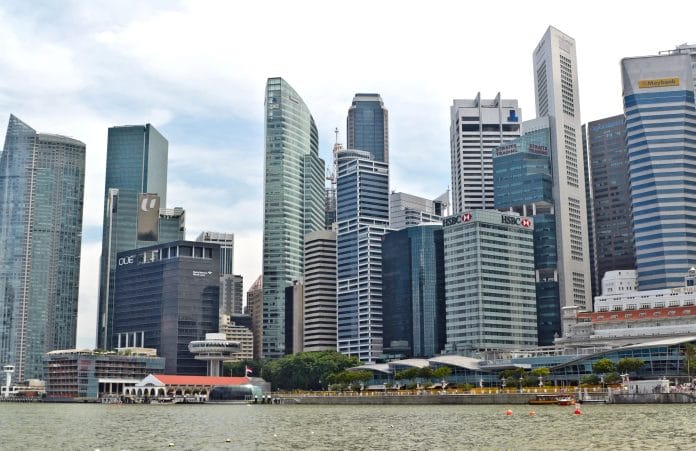
Bloomberg Intelligence expects Singapore to maintain steady economic growth over the next several years as the city-state leverages artificial intelligence adoption, wealth management inflows and shifting global trade patterns in an increasingly fragmented world economy.
In its latest report, Singapore Briefing 2026: Globalization’s Poster Child Faces Up to a Less Global Era, Bloomberg Intelligence (BI) projects Singapore’s gross domestic product (GDP) to grow around 3 per cent annually between 2027 and 2030, outperforming other developed Asia-Pacific economies.
The report said GDP growth is expected to moderate to 2.5 per cent in 2026 after an outsized 5 per cent expansion in 2025, which was driven by AI-led investment and front-loading of spending ahead of US tariff measures.
Over the longer term, growth is expected to settle at 2 to 3 per cent in most years, with expansion potentially reaching 4 per cent when global conditions are favourable.
Bloomberg Intelligence Senior ASEAN Banks Analyst Sarah Jane Mahmud, who led the report, said Singapore is turning global disruption into opportunity.
“Singapore’s economic model rests on its ability to punch above its weight as a financial centre and magnet for multinational investment,” she said.
“The city-state is positioning itself as a stable wealth-management destination and semiconductor supply-chain anchor for Southeast Asia.”
The report noted that despite rising protectionism and continued US-China tensions, Singapore is well placed to benefit as trade flows are redirected rather than diminished, supported by its strategic position near the Strait of Malacca and its services-led economy.
Services account for 68 per cent of Singapore’s GDP, while less than 17 per cent of output is directly exposed to tariffs through manufacturing.
Singapore’s role as a safe-haven destination for wealth is also expected to strengthen, supported by its strong regulatory framework, stable currency and AAA sovereign credit rating.
Assets under management across Singapore’s three largest banks — DBS, OCBC and UOB — grew 13 per cent in 2025, exceeding the average annual growth rate of 7.6 per cent recorded between 2019 and 2024.
BI also projects Singapore’s household wealth to rise about 47 per cent to S$4.8 trillion over the next five years, following more than 115 per cent growth between 2015 and 2025.
A survey of private bankers cited in the report found that more than half expect Asia’s private-banking assets to grow between 6 and 10 per cent annually through 2030, while about one-third forecast compound annual growth of more than 11 per cent.
Artificial intelligence is expected to become a major growth driver, with BI estimating that integrating AI across Singapore’s economy could generate up to S$190 billion in gains by 2030.
The largest impact is expected in advanced manufacturing, semiconductors and biomedical production, while data centres, telecom operators and digital infrastructure providers are seen as major beneficiaries.
The report said Singapore’s three largest banks could collectively increase annual pretax profit by nearly S$5 billion, or 18 per cent, over the next few years through AI adoption.
Singapore is also emerging as a key semiconductor and biomedical manufacturing hub, with biomedical output reaching S$36 billion in 2025, up from S$27 billion in 2015.
The city-state is positioning itself for a structural upgrade in the semiconductor value chain, particularly in high-bandwidth memory (HBM) and silicon photonics, with Micron Technology’s HBM facility in Singapore set to begin operations in 2026.
BI said this could disrupt North Asia’s dominance in advanced AI chip production.
Meanwhile, reforms aimed at reviving Singapore’s equity market — including tax incentives, listing rule changes and fiscal support — are expected to support listings and trading activity after a recent slowdown.
The report added that Singapore could see more exchange-traded fund (ETF) listings in 2026 after the Monetary Authority of Singapore more than doubled its listing grant for primary-listed ETFs to S$250,000.
On infrastructure, visitor arrivals are forecast to rise nearly 38 per cent to around 24 million between 2024 and 2040, supporting passenger growth for Singapore Airlines and the expansion of Changi Airport, which plans to increase annual passenger capacity to 140 million by the mid-2030s with Terminal 5.
However, BI warned that labour shortages, productivity constraints and climate adaptation will remain critical challenges.
Singapore’s workforce has been shrinking since 2017, while growing demand from fintech and AI sectors is intensifying competition for skilled labour.
The report also highlighted the strategic importance of the Johor-Singapore Special Economic Zone, which is expected to improve access to land, labour and regional growth opportunities for Singapore-based companies while deepening cross-border business ties with Malay


