


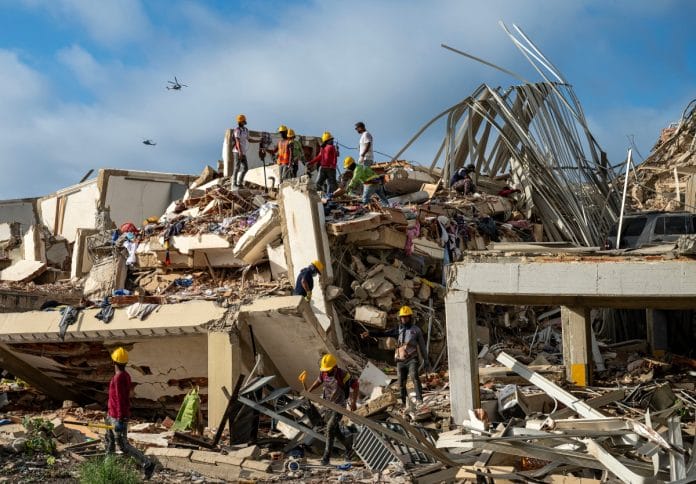
The death toll from the twin earthquakes that struck Venezuela has climbed above 1,400, as international rescue teams continue to arrive and search operations intensify across the hardest-hit coastal regions, authorities said on Saturday.
The latest figures underline the scale of destruction caused by the powerful quakes, which struck on Wednesday and triggered hundreds of aftershocks, flattening buildings and leaving entire communities across La Guaira and parts of Caracas in ruins.
Rescue operations remain focused on locating survivors trapped under collapsed structures. However, officials have warned that conditions are becoming increasingly difficult.
According to Reuters, more than 1,600 foreign rescuers have now entered the country, with additional teams expected in the coming days. The international response has brought specialised equipment and personnel from multiple countries, supplementing local crews who have been working continuously since the disaster began.
In Caraballeda, one of the worst-affected areas in La Guaira, rescue teams have been deployed using helicopters that ferried personnel into makeshift landing zones near the coast. Witnesses described a constant flow of aircraft dropping off search teams before immediately returning for further rotations, as efforts intensified to reach damaged residential blocks and collapsed apartment buildings.
Despite the growing international presence, residents and volunteers in several districts have reported uneven access to heavy machinery and delays in official coordination. In parts of La Guaira and neighbouring areas, families have been digging through rubble by hand due to a lack of sufficient equipment, often working alongside volunteer groups and informal rescue efforts.
Authorities have restricted access to La Guaira and imposed checkpoints along key routes from Caracas, citing the need to prioritise emergency vehicles. Only authorised personnel and accredited rescue teams are being allowed through, a move officials say is intended to prevent congestion on already strained roads.
The humanitarian impact continues to grow. In addition to the confirmed fatalities, uncertainty persists over the number of people still missing. A government-aligned tally lists hundreds as unaccounted for, while an opposition-run tracking website suggests more than 55,000 people have yet to be located, highlighting discrepancies in reporting amid the chaos.
The scale of the disaster has prompted warnings from seismologists. The US Geological Survey estimated that the quakes—measuring 7.2 and 7.5 magnitude—could ultimately result in more than 10,000 deaths, placing them among the deadliest seismic events in Latin America in recent decades.
In affected neighbourhoods, entire communities remain displaced. Many residents are sleeping outdoors due to fears of further aftershocks and structural instability. Emergency shelters have been set up in some areas, but demand continues to exceed capacity, particularly in coastal districts where damage has been most severe.
Power supply across the region has begun to stabilise, though outages persist in several areas. Venezuela’s electricity infrastructure, already weakened by years of underinvestment and sanctions, has struggled under the additional strain caused by damaged transmission lines and emergency demand.
The crisis has also drawn international political attention. Interim President Delcy Rodríguez, who has faced scrutiny over the government’s disaster response, is now managing one of the most severe humanitarian emergencies in recent Venezuelan history. Meanwhile, opposition figures, including María Corina Machado, have renewed calls for expanded international assistance, as debate continues over the coordination of relief efforts.
In Washington, officials indicated that additional support is being prepared. A senior US administration official said a funding package worth several hundred million dollars could be announced shortly, adding to existing commitments. The move follows earlier aid pledges and reflects growing international engagement in the aftermath of the disaster.
Religious leaders have also voiced solidarity. Pope Leo expressed prayers for victims, their families, and emergency workers, urging continued global support for relief efforts.
As search operations continue, the focus remains on finding survivors before the critical window closes, while authorities and aid agencies work to stabilise conditions in communities still reeling from the destruction. The situation remains fluid, with rescue teams warning that casualty figures are likely to rise further in the coming days.


