


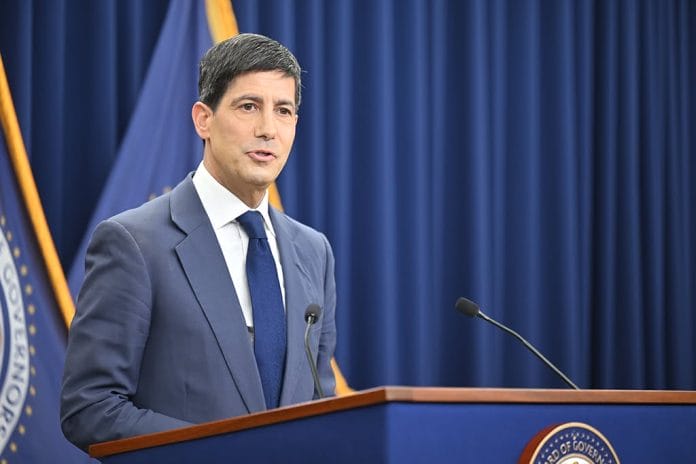
The Federal Reserve’s increasingly hawkish tone under new Chair Kevin Warsh may be part of a strategy to tighten financial conditions without ultimately delivering the interest rate hikes currently expected by markets, according to Standard Chartered.
In its latest market commentary, Standard Chartered’s Global Chief Investment Office said Warsh’s recent remarks have focused heavily on restoring inflation to the Fed’s 2% target, triggering expectations of higher US interest rates, supporting the US dollar and weighing on gold and equity markets.
The bank’s Global Head of Equity Strategy, Rajat Bhattacharya, said Warsh’s communication appears designed to influence market behaviour by tightening financial conditions in the short term.
“We believe that’s part of the plan. Warsh is talking tough on inflation precisely to tighten near-term financial conditions, so he does not have to eventually deliver the rate hike markets are expecting,” he said.
Warsh has spoken publicly only twice since being appointed Fed Chair by US President Donald Trump on 22 May.
While his first comments were largely ceremonial and aligned with his stated preference for limiting Fed communication, his remarks following the latest Federal Open Market Committee (FOMC) meeting were interpreted as a strong anti-inflation signal.
Standard Chartered noted that Warsh avoided providing traditional forward guidance but maintained a clear focus on bringing inflation back to target, highlighting that inflation had remained above the Fed’s objective for the past five years.
The bank said the comments pushed up short-term US bond yields, strengthened expectations of a possible rate hike this year, lifted the dollar to a 13-month high and triggered a pullback in equity markets from record levels.
Lower Oil Prices Could Limit Fed Rate Hike Path
Despite the hawkish messaging, Standard Chartered expects the Fed to face constraints in raising rates this year.
One key factor is the sharp decline in oil prices, which have fallen around 35% from their April peak to levels close to those seen before the recent geopolitical tensions.
The bank expects lower energy prices to help ease inflation pressures in the coming months, suggesting that the latest rise in US headline inflation to a three-year high of 4.1% in May could represent a peak.
The US 10-year Treasury yield has already declined by around 30 basis points from its May high as inflation expectations moderated alongside lower oil prices.
Other factors limiting the likelihood of a rate hike include signs of renewed weakness in the US labour market, with initial and continuing jobless claims showing signs of deterioration.
Standard Chartered also highlighted Warsh’s view that artificial intelligence could boost productivity and reduce wage pressures, which may help contain services inflation.
The upcoming US mid-term elections could also make a rate increase politically challenging, particularly as President Trump has repeatedly called for lower interest rates.
“With constraints against a rate hike, we see limited USD upside, especially with extremely stretched bullish USD positioning, and limited gold downside from here,” the bank said.
Risk Remains From Stronger US Growth
However, Standard Chartered cautioned that the main risk to its base case of a Fed rate pause would be stronger-than-expected US economic growth.
Recent purchasing managers’ indices showed US business sentiment continuing to outperform Europe and Japan, suggesting the possibility of widening growth differences that could support the dollar.
A stronger US growth and employment environment, despite emerging impacts from AI-driven disruption in sectors such as finance and technology, could increase the possibility of a Fed rate hike.
Such a scenario, combined with resilient corporate earnings, could continue supporting risk assets.
Investors Should Broaden Equity Exposure
Despite near-term challenges from a hawkish Fed, elevated investor positioning and a wave of initial public offerings, Standard Chartered said corporate earnings expectations remain positive in the US and Asia ex-Japan markets.
The bank recommended investors diversify equity exposure beyond the US and increase allocations towards Asia ex-Japan markets.
Within technology, the bank favours expanding exposure beyond semiconductors into communications services in both the US and China.
Outside technology, Standard Chartered highlighted opportunities in US healthcare, euro area financials and industrials, as well as Japanese financial stocks.
The bank said a potential stabilisation in inflation, a pause in Fed tightening and continued earnings resilience could provide support for markets despite ongoing macroeconomic uncertainty.

