


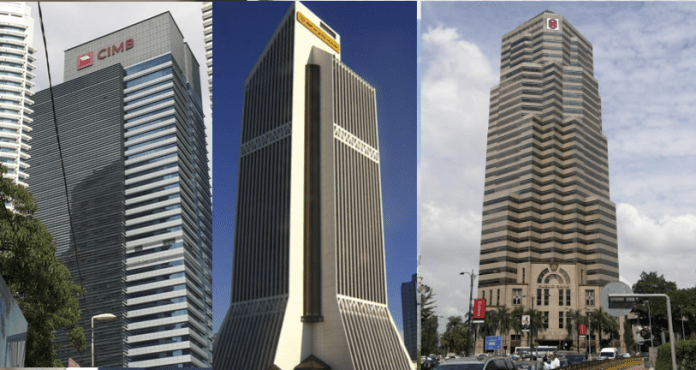
RHB Research has maintained its “Overweight” stance on Malaysia’s banking sector, citing resilient loan growth, healthy liquidity conditions and strong capital buffers, with Public Bank, Malayan Banking (Maybank) and AMMB Holdings (AmBank) retained as its top picks.
The research house said Bank Negara Malaysia’s (BNM) May 2026 banking statistics showed system loans growth remained steady at 5.7% year-on-year (YoY), slightly improving from 5.6% YoY in April 2026 and above the 5.3% recorded in May 2025.
The growth momentum was mainly supported by the non-household segment, which expanded 6.4% YoY, while household loans remained resilient with 5.2% YoY growth.
Within the household segment, financing for securities purchases (+7.1% YoY) and hire purchase loans (+5.9% YoY) continued to be key contributors. Meanwhile, business lending growth was driven by sectors including electricity, gas and water (+38.1% YoY), transport, storage and communications (+21.1%), and real estate (+8.3%).
RHB noted that lending indicators remained positive, with system loan applications, approvals and disbursements for the first five months of 2026 (5M26) increasing by 5.1%, 10.6% and 4.3% YoY, respectively.
The stronger growth in approvals, particularly within the business segment where approvals surged 18.7% YoY, suggests a healthy pipeline for future loan expansion, the research house said.
The banking sector also recorded stronger deposit growth, accelerating to 4.4% YoY in May 2026, compared with 3.4% YoY in April 2026.
Current account and savings account (CASA) growth remained healthy, pushing the system CASA ratio slightly higher to 32.3%, compared with 32.1% in April 2026 and 31.0% a year earlier.
The system loan-to-deposit ratio (LDR) remained unchanged at 89.3%, although it was one percentage point higher compared with the previous year.
Liquidity conditions remained comfortable, with the banking sector’s Liquidity Coverage Ratio (LCR) at 149.2%, well above the regulatory minimum of 100%.
RHB said the strong liquidity position provides banks with sufficient buffers to support credit expansion while managing potential market volatility.
Asset quality indicators showed a mild deterioration, with gross impaired loans (GIL) rising 3.8% YoY and 2.5% month-on-month, resulting in the system GIL ratio increasing slightly to 1.43% from 1.40% in April 2026.
Household GIL ratio rose to 1.10%, while non-household GIL ratio increased to 1.92%.
By sector, the increase in impaired loans was mainly attributed to wholesale and retail trade, restaurants and hotels, transport and communications, as well as education and healthcare segments.
However, RHB noted that asset quality remained manageable, supported by stable economic conditions and collateral coverage.
The system loan loss coverage (LLC) ratio declined to 82.6% from 83.4% previously, which the research house said could indicate banks are utilising existing provisioning buffers or that new impaired loans remain adequately secured.
Malaysia’s banking system continued to maintain strong capitalisation despite a slight moderation in capital ratios.
The Common Equity Tier 1 (CET-1) ratio eased marginally to 14.0% from 14.1% in April 2026, while the total capital ratio remained steady at 17.5%.
RHB said capital levels remain comfortably above regulatory requirements, providing banks with sufficient capacity to support credit growth and absorb potential macroeconomic shocks.
Overall, the research house expects Malaysia’s banking sector to remain supported by steady economic activity, improving loan demand and favourable liquidity conditions.
It reiterated its Overweight recommendation on the sector, with Public Bank, Maybank and AmBank identified as preferred banking counters.


