


More than 300 senior government officials, ambassadors, policymakers and corporate leaders from ASEAN, Hong Kong and China’s Greater Bay Area (GBA) gathered at the Fullerton Ocean Park Hotel Hong Kong for the South China Morning Post (SCMP) Greater Bay Area-ASEAN Summit 2026, where the buzz of rapid progress in development and trade can be felt at the corridors of the event hall.
BusinessToday was invited for the high-profile summit which brought together representatives from the Hong Kong Special Administrative Region (HKSAR) Government, ASEAN member states, business leaders and investors to explore new opportunities for cross-border trade, investment, technology collaboration and talent mobility amid an increasingly fragmented global economy. Among the summit’s sponsors were InvestSelangor and Malaysia Airlines.
The highlight of the morning was when Hong Kong Chief Executive John Lee Ka-chiu took the stage and said that the Hong Kong is leveraging its role as an international financial and wealth management hub to serve as the region’s “super connector” and “super value-adder” between ASEAN and the Greater Bay Area.
“Hong Kong is now drawing up its first-ever Five-Year Plan. It will be a strategic blueprint that maps out Hong Kong’s vision for the next five years and long beyond,” Lee said.
“That very much includes deepening our regional cooperation with ASEAN, as well as other Belt and Road economies, through our unique positioning in the Greater Bay Area.”
The Greater Bay Area, which comprises Hong Kong, Macau and nine cities in Guangdong province, remains one of China’s most dynamic economic regions, while ASEAN represents a market of nearly 700 million people.
Trade momentum continues to strengthen
Speaking at the summit, HK-ASEAN Foundation Chairman Dr Daryl Ng highlighted the growing economic links between the two regions, noting that Hong Kong continues to play a pivotal role in facilitating trade and investment flows.
He said export trade between ASEAN and the Greater Bay Area conducted through Hong Kong reached HK$680 billion in 2025, while total trade between ASEAN and Guangdong province climbed to RMB1.5 trillion, underscoring the resilience and expanding scale of regional commerce.
Ng described Hong Kong as the bridge connecting ASEAN’s rapidly expanding consumer market with the Greater Bay Area’s economy, which exceeded RMB15 trillion last year.
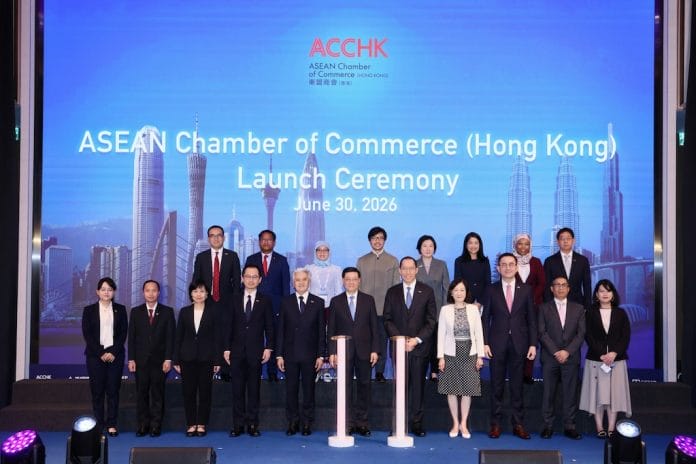
The summit also witnessed the official launch of the ASEAN Chamber of Commerce (Hong Kong), with Lee officiating the ceremony alongside Ng.
The new chamber is expected to further facilitate business collaboration and commercial partnerships between Hong Kong and Southeast Asian economies.
Asia’s stability attracting global capital
SCMP Publisher Tammy Tam said geopolitical uncertainty and increasing fragmentation of global markets are prompting international investors and businesses to look towards Asia as a stable growth destination.
“International capital and businesses are shifting focus towards the stability and immense potential that Asia offers,” she said.
“The mandate is clear: stability is essential for building, mobility for scaling, and agility for sustaining growth. Asia delivers on all three.”
Tam added that international forums such as the Greater Bay Area-ASEAN Summit play an important role in connecting policymakers, investors and industry leaders while creating new opportunities for capital flows, innovation, industrial cooperation and talent exchange.
The discussions throughout the summit centred on strengthening collaboration in digital technology, artificial intelligence, advanced manufacturing, computing power, logistics, sustainable development and talent mobility.
Ministerial-level leaders from ASEAN member states, together with senior Hong Kong and Greater Bay Area officials, also explored ways to deepen two-way investments and position the regions as an integrated economic ecosystem capable of driving long-term shared prosperity.

