


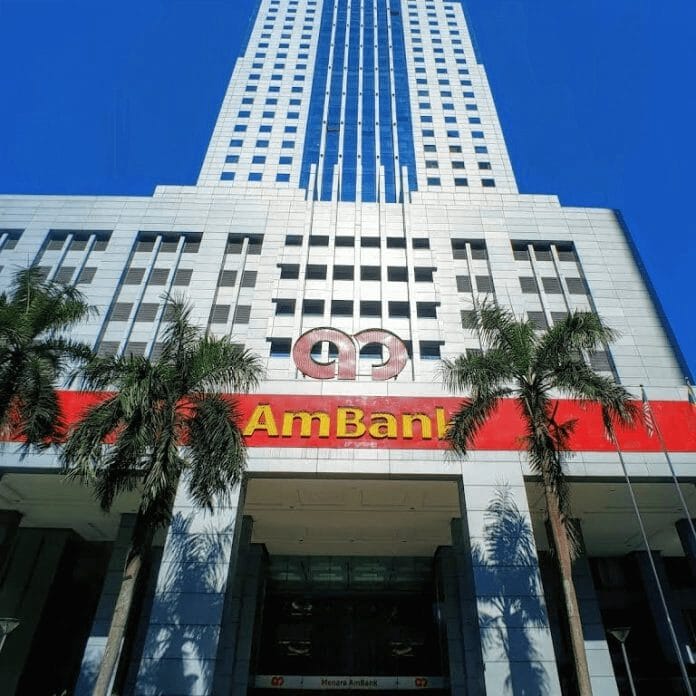
Fitch Ratings has revised the outlook on AmBank (M) Bhd’s long-term issuer default rating (IDR) to Positive from Stable, citing the banking group’s consistent execution of its business banking strategy, while affirming its long-term IDR at ‘BBB-‘.
The international ratings agency also affirmed AmBank’s Government Support Rating (GSR) and Viability Rating (VR) at ‘bbb-‘.
Fitch said the Positive Outlook reflects its expectation that AmBank will continue to strengthen its business profile and profitability through disciplined expansion, while maintaining stable asset quality.
The ratings agency noted that AmBank’s long-term rating is driven by its standalone financial strength, represented by its viability rating, which reflects the consolidated credit profile of parent company AMMB Holdings Bhd.
AmBank and AmBank Islamic together account for more than 95% of AMMB’s total assets, making them the group’s principal operating entities.
Business profile strengthens
Fitch also revised the outlook on AMMB’s business profile score to Positive from Stable, pointing to the bank’s consistent operational execution over recent years.
Although AmBank remains a mid-sized domestic lender with a market share of around 5% to 6% of Malaysia’s banking system loans and deposits, Fitch believes the group has successfully strengthened its competitive position through disciplined business growth.
The agency expects Malaysia’s operating environment to remain supportive despite moderating economic growth, underpinned by resilient domestic demand, low inflation and policy flexibility.
It added that easing geopolitical risks following progress towards an Iran-related agreement have reduced external uncertainties, although global risks remain.
SME lending expansion
Fitch noted that AmBank has stepped up lending to the small and medium enterprise (SME) segment, with overall loan growth broadly matching industry trends after two years of slower expansion.
While SME financing generally carries higher credit risk, Fitch said this has yet to translate into weaker asset quality, with the bank’s impaired loan ratio remaining stable.
The agency expects credit costs and impaired loans to remain manageable over the near term, supported by prudent underwriting standards and a largely secured loan portfolio with moderate loan-to-value ratios.
However, it cautioned that risks remain tilted towards the SME sector should economic conditions deteriorate.
Profitability and capital remain solid
According to Fitch, AmBank’s earnings for the financial year ended March 2026 were supported by stronger net interest margins, one-off impairment write-backs and higher trading income arising from market volatility.
The agency expects profitability to remain broadly stable over the next 12 to 18 months, driven by steady loan growth and disciplined cost management.
AmBank’s capital position also remains healthy, with its Common Equity Tier 1 (CET1) ratio standing at 14.8% at the end of March 2026.
While the ratio is expected to moderate as dividend payouts increase and risk-weighted assets grow, Fitch believes capital buffers remain robust.
Funding continues to be largely deposit-based, although the group’s 98% loan-to-deposit ratio remains higher than many domestic peers.
Customer deposits grew 4% year-on-year, led mainly by time deposits, while current and savings account (CASA) growth slowed to 2%, reducing the CASA ratio slightly to 35.4% from 36.0% a year earlier.
Upgrade depends on continued execution
Fitch said AmBank’s ratings could be upgraded if the group continues to strengthen its business profile through sustained execution and financial performance while maintaining its CET1 ratio above 14% and successfully managing risks associated with its expanding SME loan book.
Conversely, the outlook could revert to Stable if business expansion leads to weaker asset quality or if financial metrics deteriorate materially.
The agency added that the bank’s Government Support Rating reflects its view that there remains a high likelihood of state support if required, despite AmBank not being designated as one of Malaysia’s domestic systemically important banks (D-SIBs).

