


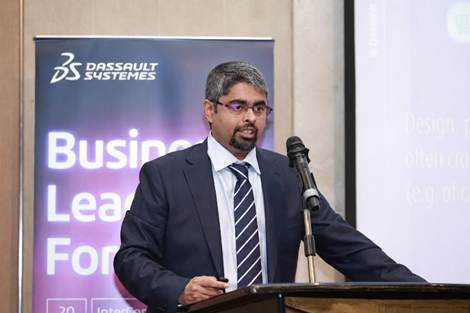
The following commentary is contributed by Dassault Systèmes’ AP SOUTH Industry Process Consultant Director Venkat Balasubramanian
Across ASEAN, industries are entering a new phase of transformation. From large-scale infrastructure and energy transition projects to increasingly sophisticated manufacturing ecosystems, organisations across the region are facing growing pressure to deliver faster, operate more sustainably and manage rising complexity amid an increasingly competitive global environment.
At the same time, ASEAN is rapidly emerging as an important hub for advanced manufacturing, electronics, aerospace and digital innovation. As global supply chains continue to diversify, countries across the region are racing to strengthen industrial resilience, attract high-value investments and move up the value chain through technology and innovation.
Artificial intelligence (AI) is expected to play a central role in this transition. However, much of today’s AI conversation remains focused on chatbots, generative AI and language-based assistants. While these technologies are useful in improving productivity and automating routine tasks, industries such as manufacturing, aerospace, energy and infrastructure require a different kind of AI — one that understands how systems behave in the real world.
This is where industrial AI is beginning to redefine the future of industry across ASEAN.
Unlike conventional AI systems that rely primarily on language and data patterns, industrial AI combines AI with physics-based simulation, engineering knowledge and real-time operational data. In practical terms, it allows companies to create virtual environments where products, factories, infrastructure and industrial processes can be tested digitally before they are built or deployed in the real world.
For ASEAN economies seeking to strengthen industrial competitiveness while managing sustainability goals and workforce challenges, this capability is becoming increasingly important.
Among ASEAN nations, Malaysia is particularly well-positioned to benefit from this next phase of industrial AI adoption.
As the country accelerates ambitions under the New Industrial Master Plan 2030 (NIMP 2030), expands its role in advanced manufacturing, strengthens its aerospace ecosystem and pushes toward a more digital and sustainable economy, the conversation around AI is also evolving.
Malaysia has already established itself as a major player in electrical and electronics manufacturing, semiconductor production, aerospace components and industrial engineering. But as industries become more complex, the next phase of competitiveness may depend not only on production capacity or labour efficiency, but on how intelligently organisations can design, simulate, optimise and predict outcomes before physical execution even begins.
At Dassault Systèmes, this approach is enabled through AI-powered virtual companions such as AURA, LEO and MARIE, developed on the 3DEXPERIENCE platform. These specialised industrial AI assistants are designed to help organisations make faster, more informed and more accurate decisions across engineering, operations and project management.
For example, project leaders can gain real-time visibility into scheduling risks and operational changes before they escalate into costly delays. Engineers can run simulations and validate complex design decisions within minutes rather than weeks. Materials specialists can explore scientific trade-offs and test new ideas virtually, reducing the need for expensive physical prototyping.
More importantly, these systems allow organisations to understand the downstream impact of decisions before implementation begins.
This capability could become increasingly important for Malaysia as industries face growing pressure to improve productivity, manage sustainability targets and compete for high-value investments.
In manufacturing, industrial AI could help Malaysian factories reduce downtime, improve quality control and optimise production planning through predictive simulation. In semiconductor and precision engineering environments, it could accelerate product validation while reducing costly redesign cycles.
For Malaysia’s growing aerospace sector, industrial AI presents significant opportunities across aircraft component manufacturing, maintenance, repair and overhaul, and supply chain coordination. Engineers could simulate component performance, manufacturing constraints and maintenance scenarios virtually before physical work begins, improving efficiency, traceability and compliance.
The same applies to infrastructure and energy transition projects, where delays, fragmented workflows and late-stage design changes often result in escalating costs. AI systems grounded in real-world engineering principles can help organisations simulate different scenarios early, detect operational risks sooner and improve long-term planning outcomes.
Importantly, the future of industrial AI is not about replacing people.
Instead, it is about augmenting human expertise and enabling engineers, technicians and project teams to make better decisions faster. As industries face talent shortages and increasing complexity, AI can help younger professionals access decades of accumulated industrial knowledge while allowing experienced teams to focus on higher-value problem-solving and innovation.
This is particularly relevant for Malaysia as the country works to develop a highly skilled, technology-enabled workforce capable of supporting next-generation industries.
Trust will also play a defining role in industrial AI adoption.
In high-stakes sectors such as aerospace, manufacturing, infrastructure and energy, AI cannot operate as a “black box”. Organisations need systems that are explainable, transparent and grounded in scientific and engineering realities. This is why simulation-driven industrial AI represents an important evolution — moving AI beyond general recommendations toward predictive intelligence capable of modelling how systems behave in real-world conditions.
The economic implications are significant.
Globally, organisations adopting industrial AI are beginning to see measurable improvements in operational efficiency, cost optimisation, product quality and project execution. Faster design validation, earlier risk detection and better collaboration across teams can translate into shorter development cycles, stronger productivity and improved competitiveness.
For Malaysia, industrial AI could also strengthen the country’s attractiveness as a regional hub for advanced manufacturing and high-value engineering. As global companies rethink supply chains and seek technologically capable production ecosystems, nations that successfully integrate industrial AI into their industrial strategies may gain a meaningful competitive advantage.
Across ASEAN, the countries that are able to combine industrial capabilities with intelligent, simulation-driven AI may ultimately emerge as the region’s next industrial leaders.
The future of AI in Malaysia — and across ASEAN — will not be defined solely by chatbots or digital assistants. It may increasingly be shaped by how effectively industries can combine AI with real-world engineering, simulation and operational intelligence to solve complex industrial challenges and build more resilient, competitive and sustainable economies.


