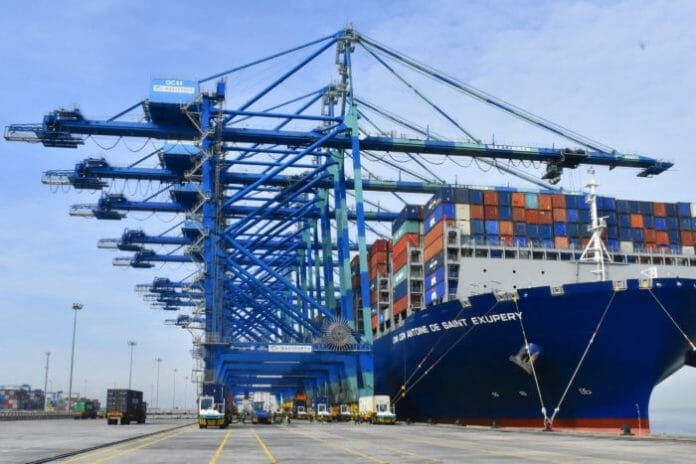
Westports Holdings Bhd delivered a strong set of first-half FY2026 earnings that met expectations, underpinned by higher tariffs and increased contribution from value-added services (VAS), despite weaker container throughput during the period, according to Kenanga Research.
The research house said Westports’ core net profit of RM681.1 million for the six months ended June 30, 2026, excluding one-off items of RM6.3 million, accounted for 60% of its full-year earnings forecast and 57% of consensus estimates.
Kenanga said the performance was broadly in line with expectations, noting that management has guided for VAS revenue to normalise in the second half of the year as storage demand eases.
Westports also declared an interim dividend of 14.98 sen per share, significantly higher than the 9.93 sen paid a year earlier.
Revenue climbs despite lower throughput
Revenue for the first half rose 34% year-on-year, although Kenanga noted that growth moderates to 30% after excluding construction revenue related to the ongoing Container Terminals 10 to 13 (CT10-CT13) expansion project, which is currently about 63% complete.
The stronger financial performance came despite a 1% decline in overall container throughput, as revenue per twenty-foot equivalent unit (TEU) surged 33% to RM240.40.
The increase was driven by a higher contribution from value-added services, which accounted for 30.7% of container revenue compared with an average of 25% in FY2025, as well as the implementation of two tariff increases of 15% and 10% that took effect in July 2025 and January 2026, respectively.
Management expects average container dwell time to gradually normalise in the coming quarters as consignees and shipping lines adjust to the higher storage charges.
Middle East conflict weighs on transhipment
Transhipment container volume declined 3% during the period due to weaker cargo flows linked to the Middle East conflict.
Kenanga noted that Middle East-bound cargo accounted for around 6.5% of Westports’ total container volume in 2025, with approximately two-thirds comprising transhipment cargo.
The port operator also turned away some Middle East-bound containers to prevent congestion in its container yards.
In addition, transhipment volumes were affected by the absence of temporary cargo linked to the Gemini shipping alliance as vessel networks normalised.
However, gateway container volume edged up 1%, supported by stronger laden imports and increased repositioning of empty containers.
Conventional cargo provides additional support
Westports’ conventional cargo business recorded a stronger performance, with throughput rising 17% year-on-year to 6.69 million metric tonnes.
Growth was driven by higher volumes of break bulk cargo, including project cargo, metal ingots and heavy-lift shipments, alongside stronger liquid bulk movements involving crude palm oil, oleochemicals and specialty fats.
Roll-on roll-off (RoRo) cargo also increased, supported mainly by deliveries of Proton’s eMas completely built-up (CBU) vehicles.
Profit growth outpaces revenue
Core net profit climbed 50% year-on-year, benefiting from stronger revenue while maintaining a stable effective tax rate of 23.4%.
Although fuel costs increased, management said energy expenses remained manageable, with fuel accounting for 24% of total operating costs in the second quarter, only marginally higher than 23% recorded in 2022 when energy prices surged following the Russia-Ukraine conflict.
Second-quarter performance
On a quarter-on-quarter basis, reported revenue declined 3% due to lower construction revenue. Excluding construction activities, however, operating revenue increased 7%, reflecting stronger business fundamentals.
Container throughput rose 7% during the quarter, driven by seasonally stronger shipping activity following the festive slowdown in the first quarter.
Transhipment volume increased 4%, while gateway container volume expanded 11%. The stronger traffic also lifted the contribution of value-added services to 30.7% of container revenue from 28.3% in the preceding quarter.
Kenanga expects earnings momentum to moderate in the second half as value-added service income gradually normalises, although Westports’ higher tariff structure and resilient cargo mix are expected to continue supporting its overall financial performance.