



Singapore has released two patriotic film akin to Michael Bay’s “Armageddon” and “World War Z” in time for National Day called “Trace Project” and “Bersama Majulah”. Too bad they’re fully AI-generated.
Trace Project’s movie’s “synopsis” (if one can call it that) is as follows:
“In the late 2030s, as Earth’s ecosystem continues to collapse, humanity launches the Mars Footprints Program, sending astronauts from every nation to establish a new civilization on Mars. Lin Jia Jun, an ordinary young man raised in Singapore’s public housing, becomes the country’s first astronaut to set foot on Mars. Through a cognitive brain-link, he shares every emotion in real time with his companion, Chen Hui Min, who remains on Earth. As the mission unfolds, Lin discovers that Mars is far from the promised land—it is a brutal test of resources, survival, and human nature. Meanwhile, Hui Min quietly watches over him from Earth. As ideals collide with reality and national duty conflicts with the longing to return home, Lin must confront one ultimate question: Is humanity’s future found in escaping Earth, or in learning to protect the home we already have?”
Bersama Majulah (a direct translation of “Together Onwards” from Malay) is a short film produced by Singapore-based AI studio Edenstone. It depicts a National Day Parade disrupted by a deadly spore outbreak that turns people into zombies. Set in the country of Lionara, it features familiar landmarks such as Marina Bay and the Merlion.
The film was created by local showrunner Joel Boh, with Golden Horse-winning producer Chan Gin Kai serving as executive producer and a theme song by local musician Dharma Sadasivan.
Pax Chen, the founder and CEO of FizzDragon, the production company behind “Trace Project”, told Mothership that the concept of the film began from a novel she “personally” wrote.
Drawing from her academic background in electrical engineering, which she studied at the National University of Singapore (NUS), she said she “always had a strong interest in space, aerospace and scientific research”.
“At one point in my life, I wanted to pursue aerospace engineering and scientific research myself,” she said.
According to Chen, the movie’s premiere on National Day was a suggestion from a senior figure at the Singapore Film Society.
“We felt that National Day was an appropriate moment to present a fictional perspective on Singapore’s future,” she said.
FizzDragon’s previous feature film, the fully AI-generated film “Pirate Queen: Zheng Yi Sao”, involved a team of more than 130 creators from 13 countries.
However, for “Trace Project”, FizzDragon worked with a smaller team of about 10 people across three countries.
The move was made to enable a “global creator ecosystem”, where writers, artists, filmmakers and creators from different countries could develop their own intellectual property and use AI as part of the creative process, she said.
“It is also a real-world experiment about whether a small team, using a new generation of creative technology, can reach beyond the limitations that traditionally determine what stories get made,” Chen said.
“That is why the film is particularly meaningful to me,” she added.
However, audiences seem to disagree. Many have rightfully labelled the film “AI slop” and a disgrace to the local filmmakers who work hard on human-made productions. The author too notes that one of the actors on Trace Project’s poster looks suspiciously like American Psycho-era Christian Bale.
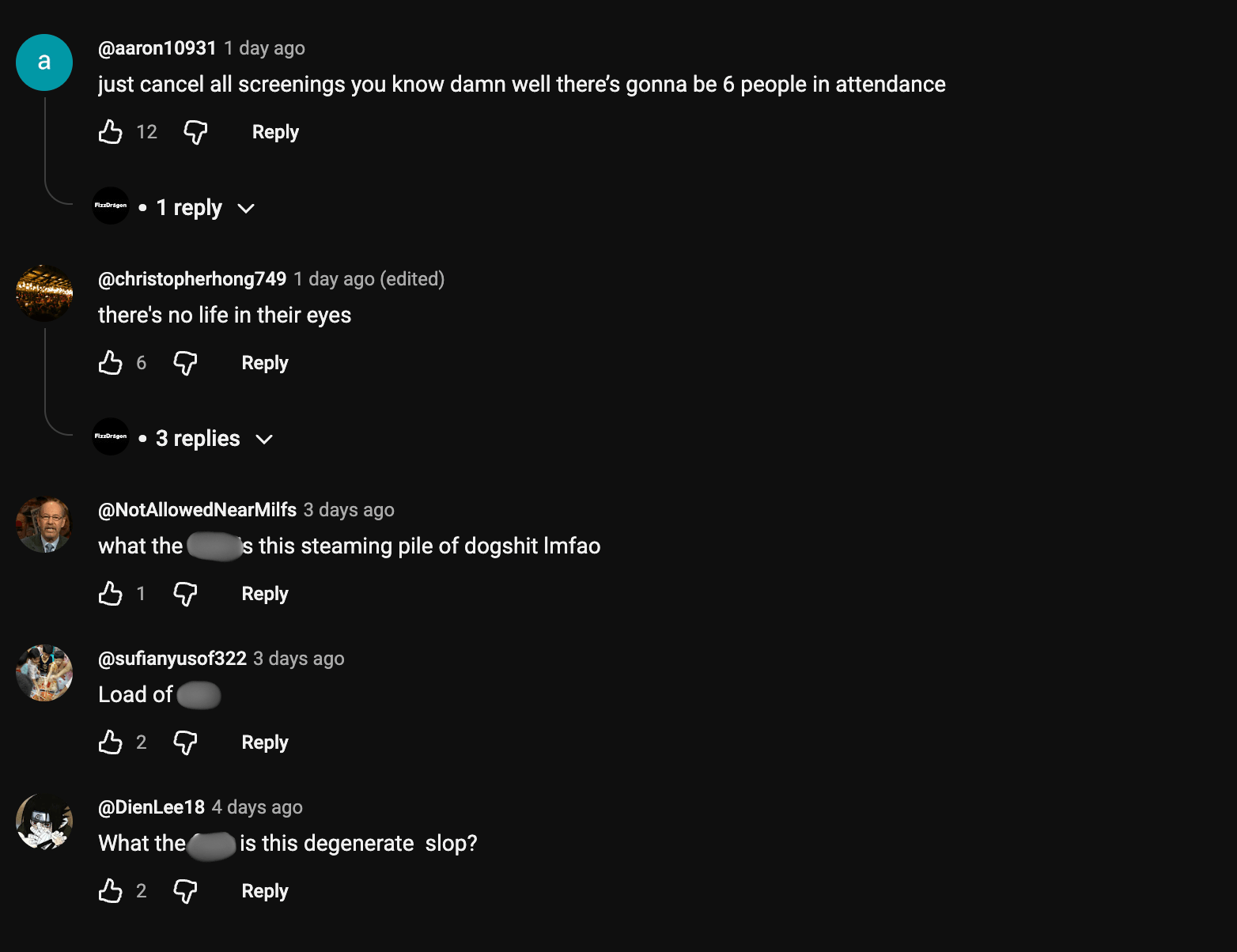
A few commenters also made their feelings clear on YouTube, with one noting: “I cannot believe AI slop like this made it to the local news. Bad directing, cringy dialogue, actors spoke with an American accent, messy timeline. This is a good example of when AI should not be used.”
Addressing the criticism, Chen said “every new product inevitably faces criticism”.
“Those who dismiss AI as ‘slop’ might do well to look at the scale of the AI creative economy worldwide today, the jobs it has generated and the opportunities it has unlocked,” she said.
The debate comes during a time when AI is creeping into the arts sphere.
US-based generative video company Runway held its fourth annual AI Festival in July, while several AI film festivals are scheduled later this year.
At the same time, major film institutions continue to emphasise the role of human creativity.
According to Reuters, organisers of the Cannes Film Festival have not outrightly banned AI, but films primarily driven by generative AI are not eligible to compete for the Palme d’Or. Reuters also reported that Academy Awards rules issued in May state that AI actors and AI writers are ineligible for Oscars.
To Singaporeans, this will only serve to motivate up-and-coming artists, as many prefer films with a human touch. This is only proven by the success of films such as Obsession, Backrooms, The Odyssey, and more. Try as they might, AI films can never replicate the human touch.


