


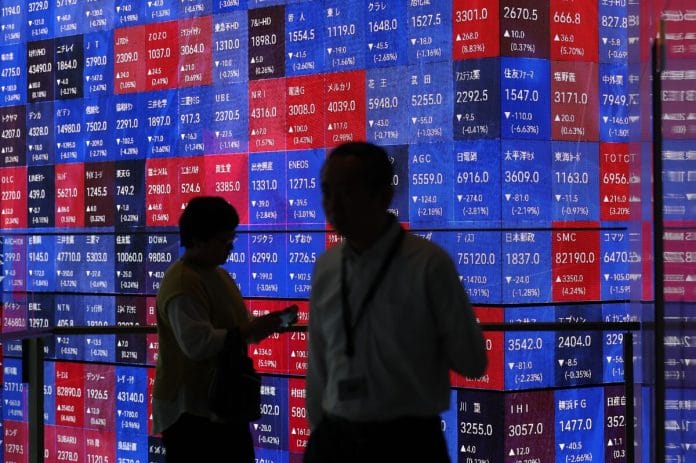
Asian stocks were largely subdued on Monday as investors waited for details of fresh US sanctions on Iran while keeping a close eye on Nvidia’s upcoming earnings and signals from the US Federal Reserve.
The MSCI index of Asia-Pacific shares outside Japan slipped 0.2%, with Japan’s Nikkei hovering near flat after losing almost 4% last week. South Korea’s Kospi fell 0.8% while Taiwan’s benchmark eased 0.5%.
US and European markets also offered little direction, with S&P 500 and Nasdaq futures marginally lower while EURO STOXX 50, DAX and FTSE futures were broadly unchanged.
Oil prices meanwhile pulled back ahead of US Treasury Secretary Scott Bessent’s planned announcement on sanctions against Iran. Brent crude fell 1% to $93.43 a barrel while US crude slipped 1.1% to $86.14, although both benchmarks had posted strong gains last week.
Bessent is expected to outline the measures later on Monday as Iran continues to control the strategically important Strait of Hormuz.
Markets are also looking ahead to Nvidia’s earnings on Wednesday, with investors facing high expectations for the chipmaker. Analysts expect quarterly revenue to nearly double to around $92 billion while full-year earnings guidance is forecast at between $103 billion and $105 billion.
The results are expected to be a major test for the broader technology sector given the elevated expectations surrounding artificial intelligence-related stocks.
Attention will then turn to Federal Reserve Chairman Kevin Warsh, who is due to speak at the Jackson Hole Symposium on Friday.
Investors are hoping for clues on the Fed’s interest-rate outlook ahead of its September 16 meeting, although JPMorgan chief economist Bruce Kasman expects Warsh’s remarks could disappoint those looking for clear guidance.
“There are several reasons to expect to be underwhelmed,” Kasman said, noting that past chairs have not wanted to front-run Fed decisions at the event.
“Warsh will rather likely focus on aspects of his ‘regime change’ agenda,” he added. “As the Fed has already been moving toward shrinking the balance sheet, and the committee gave the balance sheet some attention in the July minutes, that might be the most likely topic for him to expound upon.”
Markets currently imply around a 40% chance of a Fed rate increase at the September meeting and fully price in a move by December.
That outlook could shift depending on US inflation data due this week, with core inflation expected to remain at 3.3% in July.
Warsh is also likely to face questions over Bessent’s surprise announcement last week that the Treasury would at least double its bond buybacks in an attempt to contain rising yields and ease financial conditions.
The move has so far had limited impact, with 30-year Treasury yields rising again to 5.276%, close to their recent 19-year high of 5.3371%.
Higher yields could make bonds more attractive relative to equities while increasing the discount applied to future corporate earnings, adding pressure to stretched valuations.
In currency markets, the Canadian dollar weakened slightly after Canadian Prime Minister Mark Carney said Ottawa would retaliate against US tariffs with its own levies after trade negotiations broke down.
The US dollar gained 0.1% against the Canadian dollar to 1.3784, while Canada is set to impose tariffs on US steel, dairy products, appliances, agricultural equipment, pulp and paper and electronics.
Elsewhere, the US dollar remained under pressure after falling 0.8% against a basket of currencies last week. The euro held at $1.1675 while the dollar was little changed at 159.00 yen.
Concerns over rising US debt and policy uncertainty have also weighed on the greenback, encouraging demand for alternative assets such as gold.
Gold rose 0.4% to $4,623 an ounce after gaining more than 14% so far this month. If the metal maintains its August gains, it would mark its strongest monthly advance on record.
Reuters


