



HOTEL BASK, the newest edition of the Bask experience, will open in 2027 along Gili Meno’s western coastline, adding a new batch of spacious guest studios, high-quality restaurants, and a more contemporary expression of the BASK way of life.
Set across 400 metres of white-sand beachfront, HOTEL BASK sits beside the original BASK Gili Meno resort, with the sea on one side and the island’s tropical landscape on the other. The hotel brings together 32 guest studios, including 30 rooms measuring 63 square metres and two larger rooms at 85 square metres.
“For four years, BASK has served as a refreshing oasis within the Gili Meno landscape, and we are proud to see it preparing to welcome the world once again with the arrival of HOTEL BASK, its younger, more dynamic and stylish addition. These new tropical-modernist accommodations, complemented by world-class facilities, will deliver an intimate expression of luxury that reflects the extraordinary character of its location while embodying BASK’s latest vision for elevated hospitality experiences.” — Greg Meyer, CEO of BASK
HOTEL BASK was designed by Creative Director James Brown (known for Africola, Mexicola, Pastel, Luigi’s and Mandala Club Singapore), leading architect Rieky Sanur of RIEM Studio (collaborator on The Slow and Sea Sea Hotel), and BASK CEO Greg Meyer. The design focuses on tropical modernist living, giving it a contemporary character while remaining connected to the original BASK.
Private spaces sit quietly within the landscape, creating a low-slung sanctuary. Strong horizontal roof planes, deep balconies, and monolithic concrete frames tell a story of permanence and calm strength. Recessed glazing, perforated screens, and naturally ventilated circulation spaces respond to the tropicalclimate and surrounding environment. The architecture provides an interplay of light and shadow across the façade, subtly overlaying the architectural language of BASK Gili Meno.
The material palette is intentionally restrained, balancing sand-toned concrete, rough-hewn local stone, warm timber, dark metal, and textured plaster. Native tropical vegetation is seamlessly woven throughout the property, softening its geometric forms and embedding the structure as an earned fixture of the island landscape.
Echoes of tropical modernism, reminiscent of Geoffrey Bawa’s integration of architecture and flora, sit alongside the expressive concrete work of Brazilian modernists such as Lina Bo Bardi. Stone, timber, and concrete transition precisely to recall Carlo Scarpa’s attention to material junctions and procession.
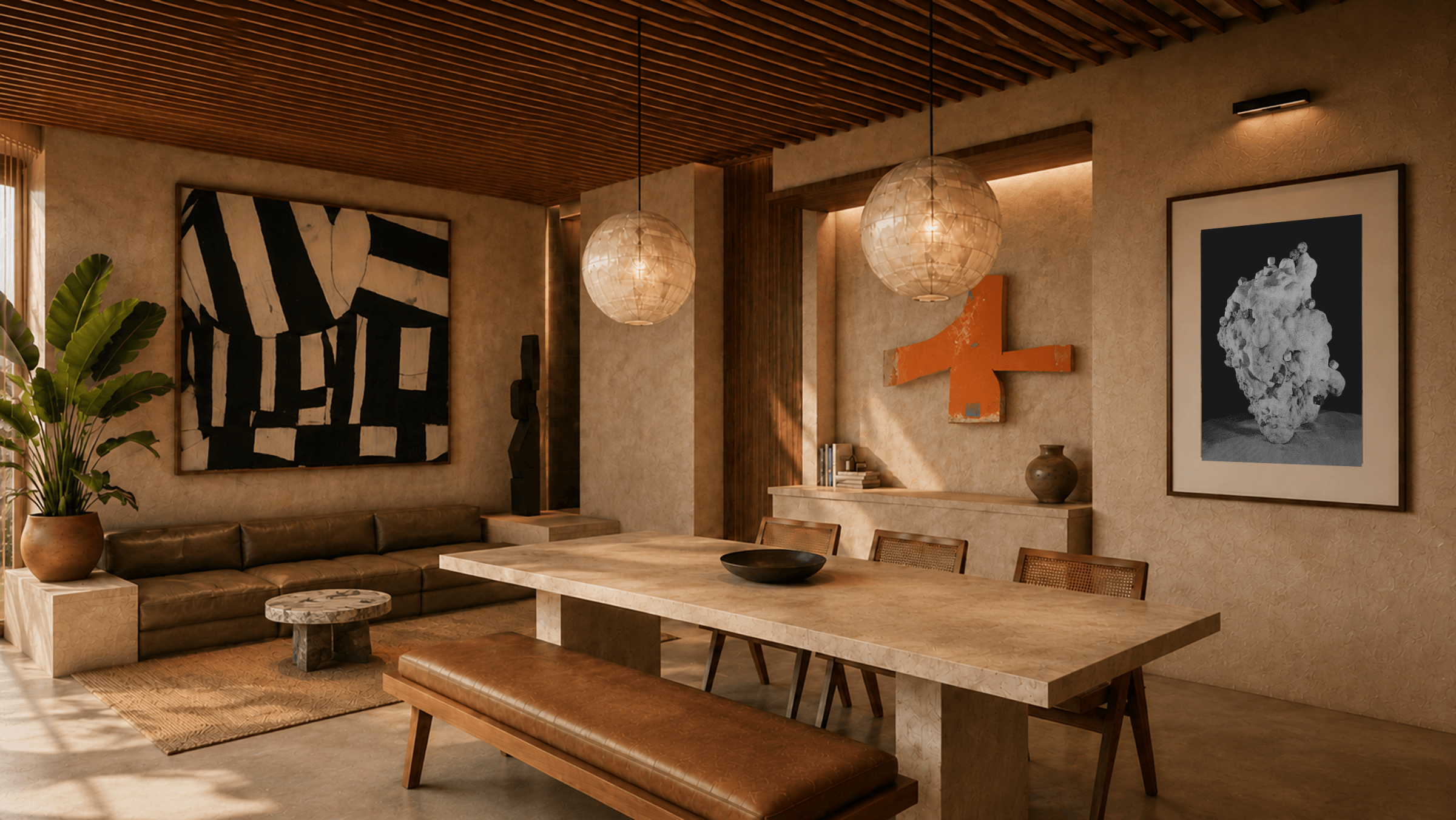
Inside, the interiors further articulate the building’s architectural language. Solid stone dining tables, built-in sofas, and broad leather lounges give weight to the importance of communal spaces. Timber chairs and natural fibre rugs introduce warmth and tactility, and counterbalance the building’s thoughtfully curated, more monumental elements.
Throughout the hotel, art acts as an expressive counterpoint to the restrained architecture. Large-scale paintings dash hyper-coloured blues, reds, pinks, and yellows across the space with gestural marks and improvised glyphs, swiftly delivering Neo-Expressionist and CoBrA influence into an otherwise disciplined habitat.
Distressed textile work from James Brown reads as a painting, banners, and architectural fragments all at once. Black and white works carry over the visual language of Rostarr from the first BASK, reinterpreted through broader, forceful strokes and subtle nods to Indonesian typography.
Monochromatic photographic work captures the abstracted, textural details of Gili Meno. In the circulation spaces, stacked black geometric sculptures work as totems, recalling Brâncuși’s vertical forms and the serial clarity of symbolic Minimalism. Throughout the hotel, furniture, artwork, and sculpture are treated as integral counterparts to the architecture rather than mere trivial embellishment.
Together, the hotel holds itself in productive tension, dragging the monumental against the informal, the raw against the refined, and the timelessness of its physical footprint against the transient art and texture of island life. You can visit their website here for more information.


