


RHB Research has maintained its OVERWEIGHT call on Malaysia’s construction sector, citing resilient contractor margins, a sizeable pipeline of data centre investments and continued infrastructure awards that should keep builders busy despite elevated material costs.
The research house named Gamuda, Sunway Construction Group (SCGB) and Kerjaya Prospek Group (KPG) as its top picks.
The latest reporting season was broadly positive, with six of the 10 construction companies under RHB’s coverage meeting expectations, three exceeding forecasts and only one falling short.
While building material prices have yet to return to levels seen before the US-Iran conflict, RHB said contractors have been managing cost pressures by partially locking in material prices, while some procurement costs are borne by main contractors.
Margins at key sector heavyweights remained healthy in 2Q26, particularly at Sunway Construction and Kerjaya Prospek.
RHB attributed the performance partly to the rapid turnaround of data centre projects, with some contracts structured on a cost-plus basis rather than fixed lump-sum arrangements, reducing contractors’ exposure to material cost fluctuations.
The finalisation of certain project accounts, which resulted in provisions being restored, also supported profitability.
The picture was less favourable for piling contractors.
Econpile, for example, experienced year-on-year margin compression due to higher diesel costs, with its net margin falling to 3.2% in 2Q26 from 10.5% a year earlier.
Material cost trends have also been mixed. Steel bar prices declined 9.5% year-on-year in July to about RM2,130 per tonne, their lowest level since June 2025.
Average bag cement prices in West Malaysia, however, increased 8% to RM25.27 per 50kg bag, although RHB observed that some contractors were still able to procure cement at between RM22 and RM24 per bag.
RHB sees Malaysia’s accelerating investment in data centres and artificial intelligence as an important source of construction opportunities.
Total approved investments reached RM218.5 billion in 1H26, up 11.7% year-on-year, with about 44% originating from data centre and AI-related projects.
Citing Cushman & Wakefield, RHB said Johor has a data centre pipeline totalling 2,486MW.
Based on a conservative construction cost assumption of RM20 million per MW, the pipeline could translate into a potential RM49.7 billion in construction value, providing a sizeable addressable market for contractors exposed to the sector.
RHB also highlighted the potential implications of a draft US ban on China-made data centre components.
The research house believes such restrictions could accelerate the China+1 manufacturing strategy, potentially encouraging China-based component manufacturers to relocate some production outside China, including to Malaysia.
That could generate a second layer of construction demand beyond the building of data centres themselves.
Higher data centre and cloud investments could create broader spillover effects across Malaysia’s semiconductor value chain, RHB said, potentially boosting demand for factories and other industrial properties.
Signs of this are already emerging in key industrial states.
Based on National Property Information Centre data cited by RHB, the value of industrial property transactions increased 68% year-on-year in Penang and 33% in Johor during 1Q26.
This could translate into additional construction opportunities as technology and semiconductor companies expand manufacturing and supporting facilities.
Meanwhile, infrastructure project awards reached RM33 billion in the first eight months of 2026. RHB said this was equivalent to an annualised RM49.5 billion, compared with RM58.7 billion of awards for the whole of 2025.
The research house identified several infrastructure projects that could provide the next wave of contract opportunities.
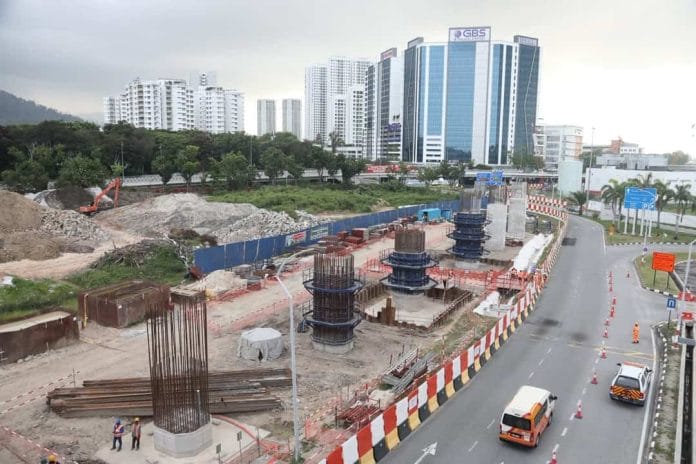
Among the key near-term projects is Segment 2 of the Penang LRT, connecting Macallum to Penang Sentral, which RHB estimates could be worth between RM4 billion and RM5 billion.
Another anticipated project is the East Coast Rail Link’s Port Klang extension, estimated to carry a value of between RM600 million and RM900 million.
With existing data centre projects progressing rapidly, further digital infrastructure investment and major public infrastructure contracts still in the pipeline, RHB expects the construction sector’s orderbook visibility to remain healthy.
However, it cautioned that a prolonged period of elevated material costs remains a key downside risk. Labour shortages could also become increasingly challenging as contractors take on larger orderbooks, potentially affecting project execution and margins.
Against this backdrop, RHB maintained its positive sector stance, with Gamuda, Sunway Construction and Kerjaya Prospek positioned as its preferred exposures to Malaysia’s continuing construction and investment cycle.


