


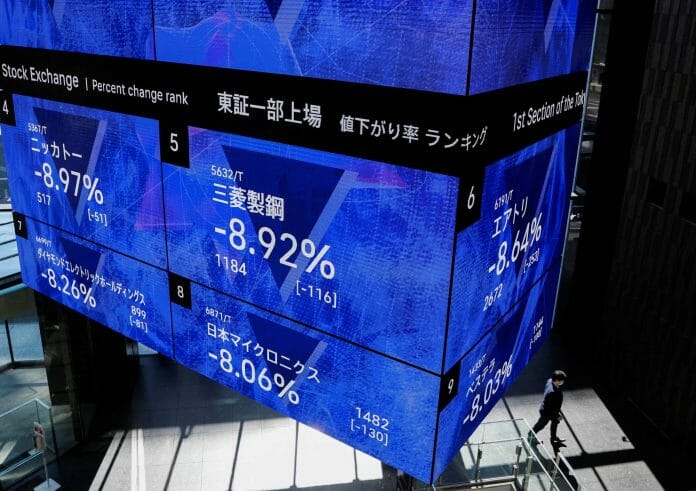
Asian share markets fell on Monday as surging oil prices heightened inflation concerns while investors braced for possible interest rate hikes from the US Federal Reserve and Bank of Japan this week, Reuters reported.
Brent crude rose 2.6% to US$107.36 a barrel, after gaining almost 9% last week, while US crude climbed 2.4% to US$102.48.
The renewed oil rally came as fresh strikes in Saudi Arabia and attacks on ships in the Gulf added to supply concerns. An attack on a Saudi oil pipeline and the Houthis’ advance towards a strategic island near the Bab el-Mandeb Strait have raised fears that disruptions to key energy routes could persist.
A planned meeting in Oman between Iran and Gulf Arab states over a possible deal to reopen the Strait of Hormuz was also postponed.
The oil surge has added to concerns that inflation could remain elevated, just as markets are pricing in an 86% chance of a 25-basis-point Federal Reserve rate hike on Wednesday. Markets also see a 76% chance of the Bank of Japan raising its policy rate by 25 basis points to 1.25% on Friday.
JPMorgan chief US economist Michael Feroli said, “We now expect the Fed to hike twice this year, in September and December.”
He added, “At this stage, failing to back up words with action could put the credibility of the institution at risk.”
Asian equities came under pressure, with Japan’s Nikkei falling 1.7% and South Korea’s Kospi dropping 3.3%. MSCI’s broadest index of Asia-Pacific shares outside Japan slipped 0.8%.
Higher bond yields have also weighed on equity valuations, with the 10-year US Treasury yield at 4.967%.
Despite the pressure from higher borrowing costs, Goldman Sachs chief US equity strategist Ben Snider said strong corporate earnings could continue to support Wall Street.
“Equities typically struggle when the Fed starts to hike rates, but we expect the bull market to continue,” he said.
Meanwhile, gold slipped 0.3% to US$4,336 an ounce as higher bond yields reduced the appeal of the non-interest-paying asset.


