


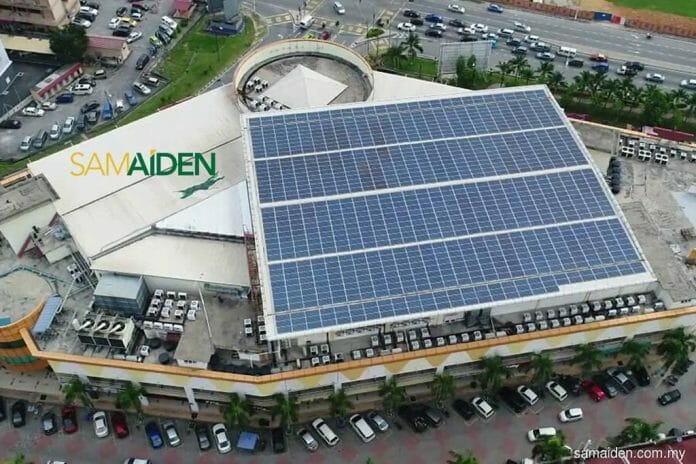
RHB Research has raised its target price for Samaiden Group Berhad to RM3.00 from RM2.42, implying a potential upside of 26%, as the government’s reduction in system access charges (SAC) under the Corporate Renewable Energy Supply Scheme (CRESS) is expected to accelerate renewable energy project awards.
The research house maintained its BUY recommendation on Samaiden, identifying the solar engineering, procurement, construction and commissioning (EPCC) company as a potential beneficiary of the government’s CRESS Acceleration Package.
The revised SAC of 14 sen per kilowatt-hour (kWh) for firm renewable energy supply represents a 30% reduction from the previous rate of 20 sen/kWh.
RHB estimates that the lower charge could improve project internal rates of return (IRR) from the high single-digit range to the low teens, making more CRESS projects commercially viable and encouraging renewable energy developers to proceed with investments. It also expects more CRESS agreements to be signed in the coming months, given the requirement for eligible projects to achieve commercial operation by Dec 31, 2028.
The research house noted that construction could take up to 24 months, leaving developers with a relatively tight window to secure agreements, financing and construction capacity.
Under the acceleration package, projects must also have a minimum contractual period of 10 years to provide greater long-term cost certainty for developers and financiers.
Projects that fail to meet the requirements will be subject to the prevailing SAC rates at the time.
RHB said the government’s new requirements for data centre investments could further accelerate CRESS adoption.
These include securing customers for data centres, maintaining a minimum 30% renewable energy mix and establishing energy supply agreements with tenures of at least 10 years.
With electricity grid prices rising, RHB expects more data centre operators to enter into CRESS agreements to secure long-term green electricity tariffs.
The research house said CRESS could eventually become a major growth driver for Samaiden, potentially succeeding Large Scale Solar (LSS) projects as a significant source of new contract awards.
Samaiden’s outstanding order book stood at RM435.8 million as at the end of FY2026.
RHB said the company has a tender book worth approximately RM3.5 billion, with CRESS projects accounting for 70%, equivalent to about RM2.45 billion in potential contracts.
The research house maintained its base-case assumption of RM1.5 billion in LSS6 contract wins for Samaiden, representing an estimated market share of 10% to 12%.
Additional CRESS contract awards could provide further upside to the group’s earnings and valuation.
RHB raised its FY2027, FY2028 and FY2029 earnings forecasts by 16.2%, 35.7% and 31.8%, respectively, after incorporating an additional 100MW of assumed CRESS order book replenishment with a 50% battery storage ratio.
The revised forecasts reflect expectations that solar projects integrated with battery energy storage systems will become increasingly attractive under the lower SAC framework.
RHB said potential contract wins beyond its current assumptions could provide further upside to its revised RM3.00 target price.
Key risks include the discontinuation of solar incentives, intensifying competition and higher-than-expected project costs.


