


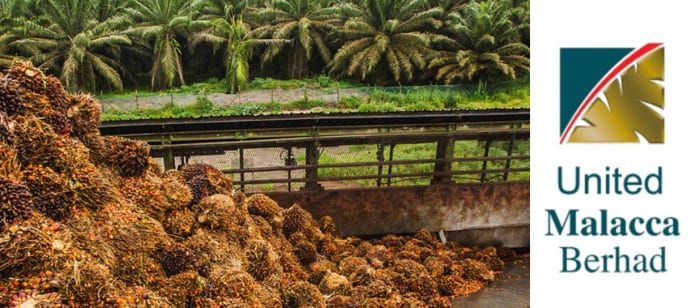
Kenanga Research expects United Malacca Bhd (UMCCA) to benefit from higher crude palm oil (CPO) prices over the next 12 months, although weaker fresh fruit bunch (FFB) production and rising fertiliser costs could limit its earnings recovery.
In its latest report, Kenanga maintained its Outperform rating and RM7.00 target price on the plantation group, citing its net cash position, dividend prospects and the potential for improving yields as its Indonesian estates mature.
The research house raised its CPO price forecast for UMCCA to RM4,700 per tonne for FY2027 from RM4,450 previously, and to RM4,500 for FY2028 from RM4,400.
Kenanga expects a severe El Niño to tighten global edible oil supplies over the next six to 12 months, supporting elevated CPO prices alongside sustained food demand and rising biodiesel consumption.
Weaker Harvest, Higher Costs To Limit Earnings Recovery
Despite the more favourable price outlook, Kenanga cut its FY2027 FFB production forecast to 456,000 tonnes from 502,000 tonnes, reflecting a weaker first-quarter harvest and anticipated weather-related pressure on yields.
It also raised its fertiliser cost assumption by 15% year-on-year.
UMCCA’s first-quarter FY2027 FFB output stood at 112,000 tonnes, down 17% year-on-year, although its average CPO selling price rose 6% to RM4,111 per tonne.
Core net profit fell 45% year-on-year to RM19.9 million, weighed down by weaker production and a realised foreign exchange loss of RM12.6 million. Excluding the realised forex loss, Kenanga estimated core profit at RM31 million, still 14% lower than a year earlier.
Following the results, Kenanga reduced its FY2027 core earnings per share forecast by 10% to 79.7 sen, while raising its FY2028 projection by 2% to 68.68 sen.
Higher Dividend Expected In FY2027
Kenanga maintained its dividend forecasts of 30 sen per share for FY2027 and 20 sen for FY2028, supported by the group’s cash position and anticipated improvement in profitability.
UMCCA’s net cash increased 9% quarter-on-quarter to RM311 million from RM286 million.
The research house also sees longer-term production upside from UMCCA’s Indonesian estates, which have an average age of about 10 years and currently yield less than 17 tonnes of FFB per hectare, below the 19-to-21-tonne range typically associated with prime production years.
Kenanga said it would consider a higher valuation multiple if subsequent quarterly results show a stronger-than-expected recovery.


