


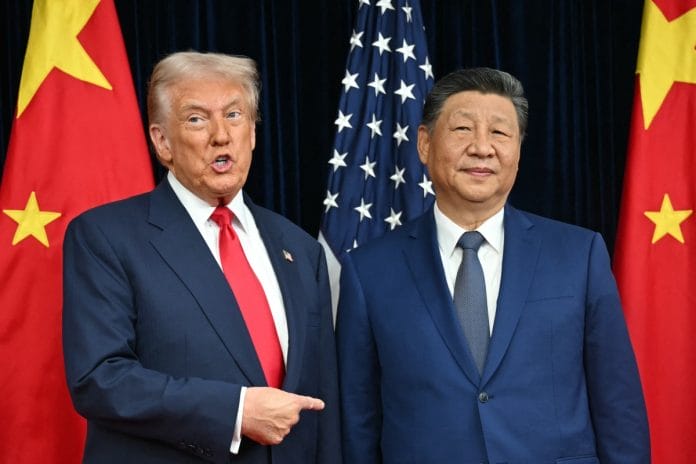
US President Donald Trump and Chinese President Xi Jinping agreed to extend their trade truce by two months during their Washington summit, but several major economic and strategic differences remain unresolved.
Here are five key takeaways from the meeting.
Trade Truce Gets More Time
The extension gives Washington and Beijing more time to negotiate on tariffs, Chinese purchases, rare-earth supplies and technology restrictions.
US Treasury Secretary Scott Bessent said China was meeting its commitment to buy 25 million tonnes of US soybeans but remained behind its pledge to purchase US$17 billion in other agricultural goods. US officials have also said rare-earth deliveries were falling short.
For companies, the extension provides temporary stability but leaves businesses facing an uncertain policy environment.
Taiwan Remains A Fault Line
Xi pressed Trump on Taiwan, urging the US to handle the issue with “prudence” and oppose Taiwanese independence.
There was no immediate White House readout of the exchange. Washington has traditionally said it does not support Taiwanese independence without explicitly stating that it opposes it.
Strategic Rivalry Still Looms
Xi invoked the “Thucydides Trap”, a theory that competition between a rising power and an established one can lead to conflict, while arguing that the risks could be overcome.
He called for regular military dialogue and stronger crisis-prevention mechanisms. Trump meanwhile pointed to areas where the two countries could cooperate, including their shared wartime history.
AI Divides Remain
Artificial intelligence was another area where the leaders struck different tones.
Trump said he wanted to avoid new AI guardrails and rely on the US Department of Justice, while Xi said the US and China had a responsibility to develop and manage AI for good and ensure that its development remained under human control.
The issue comes as both countries compete for leadership in advanced AI and technology.
Diplomacy Meets White House Spectacle
The summit was accompanied by an elaborate White House welcome, including military performances, fighter jets and a redesigned South Lawn.
But behind the ceremony, the two sides largely bought more time rather than resolving their biggest disputes, with trade, technology and strategic tensions set to remain central to US-China relations.
Reuters


