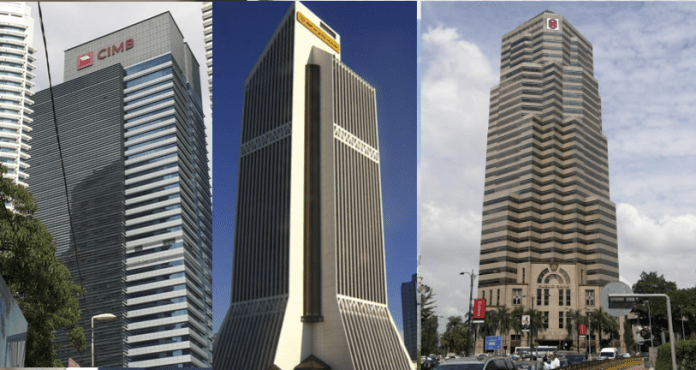
The local banking sector remains fundamentally sound, supported by robust business lending, comfortable liquidity and healthy asset quality, but a widening gap between loan and deposit growth is beginning to put pressure on funding costs and could slow the recovery in net interest margins, according to CIMB Securities.
In its latest banking sector review, CIMB maintained its Overweight stance, saying system loan growth accelerated to 5.7% year-on-year in August 2026, while deposit growth lagged at 4.2%.
The divergence reflects increasingly strong corporate credit demand as Malaysia’s investment cycle gathers momentum. Business loans expanded 6.8% year-on-year, compared with 5% growth in household lending, while business lending including development financial institutions grew 8%.
CIMB said the pattern suggests credit growth is increasingly being driven by investment, corporate expansion and working-capital requirements rather than household leverage.
Business loan applications rose 5.5% year-on-year in August while approvals jumped 30.9%, contrasting with declines of 5.1% and 10.4%, respectively, for household applications and approvals.
Funding Costs Becoming The Key Constraint
While credit demand remains healthy, CIMB said banks are increasingly contending with more expensive funding.
The ex-foreign currency loan-to-deposit ratio stood at 100.8%, while wider interbank money-market spreads and recent tightening in system liquidity are keeping marginal funding costs elevated.
This could limit the extent to which banks can rebuild net interest margins (NIMs) despite continued loan growth.
The composition of deposit growth also points to pressure beneath the surface. Islamic Tawarruq fixed deposits and wholesale deposits are becoming more important funding sources, but CIMB estimates these can cost 130 to 170 basis points more than conventional fixed deposits.
CASA deposits remained a positive factor, rising 7.9% year-on-year, helped by a 12% increase in business CASA. However, conventional fixed deposits declined 1.4%.
Liquidity, Asset Quality Still Healthy
Despite tighter funding conditions, CIMB said the banking system is not facing an immediate liquidity problem.
The system liquidity coverage ratio remained comfortable at 145.9% in August, although it eased from 148.7% in July. Islamic banks recorded a lower average of about 134%, a trend CIMB said warrants monitoring rather than representing an immediate concern.
Asset quality also remains broadly sound.
The gross impaired loan ratio edged up to 1.44% from 1.43%, while household and business impaired loan ratios remained relatively low at 1.11% and 1.92%, respectively. Loan-loss reserve coverage stood at 125.1%.
CIMB nevertheless observed rising impaired balances in selected segments including passenger vehicles, wholesale trade, retail and services, and transportation and storage.
It does not yet view those increases as evidence of broad deterioration, citing stable employment, contained inflation and ongoing investment as supportive of repayment conditions.
Capital Strength Offers Buffer
CIMB said Malaysian banks remain well positioned to withstand a more volatile global rate environment, backed by a Common Equity Tier 1 ratio of 14.1%, adequate liquidity, strong reserves and earnings visibility.
The research house also expects stronger capital positions, Basel 3.1-related benefits and balance-sheet optimisation to create greater scope for dividends and other capital returns.
For 2026, 2027 and 2028, CIMB forecasts domestic loan growth of 5.1%, 5.2% and 5.2%, respectively, while sector NIM is expected to remain broadly flat at around 2%. It projects banking sector core net profit growth of 2.9% in 2026, 5.5% in 2027 and 5.3% in 2028.
Its preferred banking stocks are Public Bank, RHB Bank and Hong Leong Bank, citing their capital return potential, dividend prospects and earnings resilience.
Overall, CIMB sees a banking system that remains healthy and profitable, but where the challenge is shifting from credit demand to funding economics: loan growth is strong, asset quality remains manageable and capital is ample, but competition for deposits and greater reliance on higher-cost funding are increasingly constraining margin expansion.