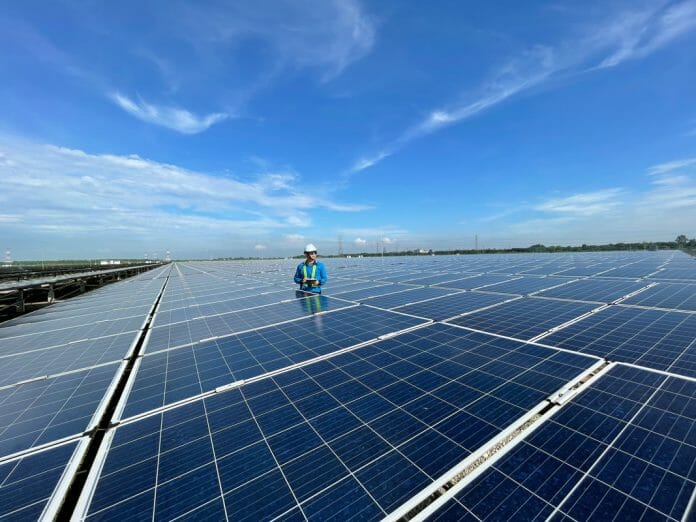
Tenaga Nasional Bhd (TNB) is strengthening its environmental, social and governance (ESG) profile through major renewable energy and hydroelectric upgrades that align with Malaysia’s national energy transition agenda.
Following an investor webinar held by TNB on Oct 1, it was highlighted that the utility group’s Hybrid Hydro Floating Solar (HHFS) project at Tasik Kenyir and the Sungai Perak Hydro Life Extension Programme (HLEP) as two initiatives supporting the transition towards a lower-carbon electricity system.
Malaysia’s National Energy Transition Roadmap (NETR) targets renewable energy accounting for 70% of installed power capacity by 2050, a target reaffirmed by the government as recently as September.
The first phase of the Kenyir project, known as Kenyir #1, will comprise 595MWac of floating solar capacity integrated with a 297.5MW battery energy storage system (BESS).
The engineering, procurement, construction and commissioning contract has been awarded to the Cypark-Sunview consortium, with commercial operations targeted for the fourth quarter of 2028.
TNB expects the project to generate a high single-digit equity internal rate of return, despite floating solar requiring around 10% to 15% higher capital expenditure than conventional ground-mounted solar.
The economics are supported by a 21-year Corporate Renewable Energy Supply Scheme (CRESS) offtake agreement with DayOne Data Centers, CIMB said.
From an ESG perspective, TNB highlighted several advantages of the floating solar project. These include higher power output from the cooling effect of the water body, the avoidance of land clearing and an estimated reduction of 650,000 tonnes of carbon dioxide emissions annually.
The project is also expected to have limited impact on Tasik Kenyir’s biodiversity as the installation will occupy only about 1.4% of the lake’s surface area.
Alongside new solar capacity, TNB is investing RM5.8 billion in rehabilitating and upgrading its ageing Sungai Perak Hydroelectric Plant network.
The HLEP covers five hydroelectric stations with a combined installed capacity of 648MW. Progress had reached 36% as of June 2026, with commissioning scheduled progressively between 2026 and 2033.
Once completed, the plants are expected to operate for another 40 years under a new power purchase agreement, allowing TNB to preserve existing renewable generation assets while extending their productive lifespan.
CIMB said both initiatives fit with the NETR’s emphasis on expanding renewable generation and energy storage capacity. The roadmap identifies renewable energy as one of Malaysia’s core energy-transition levers.
The research house maintained its BUY call and RM15.90 target price on TNB, while keeping its FY2026-FY2028 core earnings forecasts unchanged.
CIMB does not expect the projects to provide a meaningful earnings boost over the next three years, given their development timelines, but views them positively for TNB’s longer-term sustainability positioning and said they could contribute to further improvements in the group’s ESG ratings.