


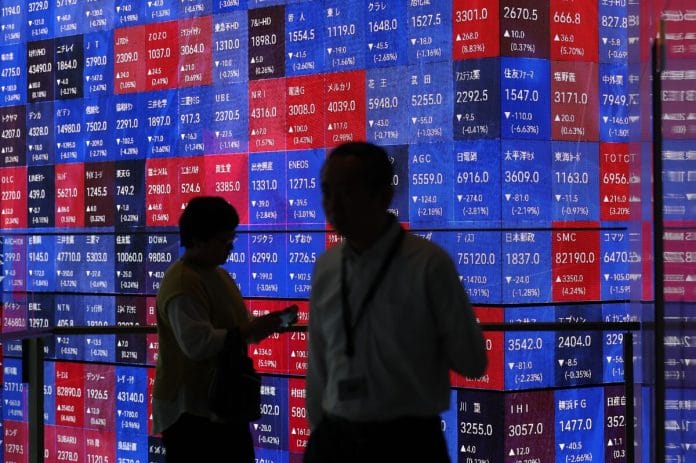
Asian shares slipped on Thursday as pressure on sovereign bond markets intensified, with major technology companies reportedly seeking billions of dollars in debt to fund artificial intelligence chip purchases.
Japan’s Nikkei fell 0.9 per cent while South Korea’s Kospi declined 0.6 per cent. MSCI’s broadest index of Asia-Pacific shares outside Japan eased 0.1 per cent.
Rising oil prices added to pressure on US Treasuries, although a strong auction of 10-year US government debt helped pull yields back from 24-year highs.
The S&P 500 and Nasdaq futures were little changed, while EUROSTOXX 50, DAX and FTSE futures each edged up 0.1 per cent after European stocks fell on Wednesday.
The Wall Street Journal reported that SpaceX, Broadcom and Oracle were seeking financing to purchase AI chips. Broadcom was reportedly looking for US$50 billion in financing, while SpaceX planned to issue US$30 billion in investment-grade debt and raise another US$10 billion in loans to buy chips from Nvidia.
Credit default insurance on SpaceX rose to record highs following the reports, while its shares and bonds fell.
DeVere Group chief executive Nigel Green warned that Nvidia was increasingly financing customers that purchase its products, potentially increasing risks for investors if expected AI-related profits fail to materialise.
“The AI build out started on cash,” Green said. “It’s increasingly running on credit, and credit changes the risk profile entirely.”
He added that debt obligations would still have to be repaid even if expected revenues did not materialise, with the borrowing ultimately held through bond funds and pension funds.
The increased spending on AI equipment could nevertheless support earnings in semiconductor and memory chip companies. Samsung Electronics projected a 783 per cent jump in third-quarter operating profit to 107.4 trillion won (US$80.17 billion), although its shares fell 0.3 per cent.
Meanwhile, sovereign bond markets remained under pressure from inflation concerns, widening budget deficits and higher cash rates.
Minutes from the Federal Reserve’s latest meeting showed most policymakers considered another rate hike likely by year-end, although they remained open to adjusting policy at each meeting.
Markets are pricing in a 19 per cent chance of a Fed rate hike this month and an 80 per cent chance of a December increase. Goldman Sachs analysts said they expected a second Fed hike in December but saw a strong possibility that the central bank could ultimately decide further tightening was unnecessary.
The two-year Treasury yield remained around 4.78 per cent while the 10-year yield rose to 5.298 per cent after reaching a 24-year high of 5.326 per cent overnight.
In Europe, concerns over France’s finances spread to other sovereign bond markets, with Bank of France head Emmanuel Moulin saying the country’s economic situation was serious but that it did not require assistance from the European Central Bank.
The euro fell 0.6 per cent overnight to US$1.1198, while the US dollar index rose to 102.22, close to an 18-month high.
The dollar was little changed against the yen at 157.90, with the Japanese currency supported by the prospect of intervention.
In commodities, Brent crude rose 0.9 per cent to US$101.14 a barrel while US crude gained 0.8 per cent to US$89.02. Gold fell to US$4,105 an ounce, close to a two-month low as higher yields reduced demand for the non-interest-bearing asset.
Reuters


