



In the web hosting industry, many providers are focusing on integrating additional tools and services into their primary offerings to create more value for the website owners.
Managed web hosting services are an all-encompassing approach for users who don’t have the technical knowledge to maintain and operate a website. Under such plans, the provider takes care of all website-related functions, from ensuring optimal performance to incorporating necessary changes and updates. This allows the owner to focus on the brand and its offerings.
BusinessToday met up with West Teoh (pic), the Chief Executive Officer and Chief Technology Officer of Gigabit Hosting Sdn Bhd or TheGigabit, who said, the hosting industry in Malaysia has undergone significant transformation over the years, especially with the rapid evolution of tech and the increasing digitalisation of businesses.
Let’s look back 10 years, only 66.6% of Malaysians used the internet. Now, that number has risen to 97.4%. But that’s just raw numbers. Let’s look at something more tangible.
“Before this new wave of globalisation, our shopping habits were quite different. We’d walk into a shop, touch and feel the product, maybe ask a salesperson for advice, and that was all we had to know about products. But now, everyone have mobile phones which allows anyone to access any information needed about any product instantly.
On internet access, Teoh said, the COVID-19 Pandemic pushed digitisation globally. During the MCO, everything from ordering groceries to conducting business meetings had to be done online. Many of those changes have continued even as the pandemic has become a thing of the past.
The major proposition here is that businesses need a digital presence now. If a company doesn’t have online presence, it might not exist in present and future times. But now that everything is digital, greater possibilities alongside threats have emerged. Malaysia has become a target for hackers, fraudsters, scammers, and host of malware attacks.
To highlight this, in Q3 2023, Malaysia was listed as the 8th most-breached country in the world, with over 494,000 accounts breached—more than the UK and more than India. Given the size and population of the country compared to the others; this data is quite scary.
“This tells us that hackers are evolving and using the call for digitisation as opportunities to steal sensitive information. At TheGigabit, we understand the importance of not just providing hosting services but also ensuring the security of our clients’ online businesses.”
Beyond security, since everyone needs to be online now, it’s understandable that business owners may not fully understand how to manage an online business. Although a vast bank of knowledge about managing websites and hosting are available on Google and YouTube, this information can be complex to most business owners today.
The has led to the need for Managed Hosting; a means for business owners to create their online presence and which is predicted to grow globally to a USD300 Billion industry by 2025. But what exactly is it?
Managed Hosting is where a hosting provider handles the entire working of a client’s website, related to his or her nature of business — from backups to security, from plug-in updates to website speed. Simply, Managed Web Hosting Services is to help everyone embark online.
Emphasising Reliability and Secure Access
As security and safety are fast becoming a concerning issue, Teoh said, you see, hackers are clever. They evolve faster than most antivirus and antimalware tools. When an exploit is found and repaired, just give it a week. Another hacker will find another exploit. That is why you need to be vigilant and aware always of global cybersecurity threats.
Let’s take WordPress as an example. WordPress is a key platform for building websites. It’s a community engine, open source, which means that everyone can access and play with the code to find exploits. What happens when you miss a critical patch? A hacker can use the exploit from before the patch to deface your website, inject malware, or breach your system.
So, companies must keep updated on cyber security threats daily and update the systems as soon as a patch is released.
TheGigabit maintains a team of highly experienced security professionals, many of whom have over half a decade of experience in the industry. Our team is always looking for news and information regarding potential threats and protecting systems from vulnerabilities before they become a danger. We also collaborate with other experts around the world, such as ESET on the increasing importance of cybersecurity, especially with the rise in cyber threats targeting businesses, how does the company differentiate itself in the market, Teoh said they have tested many security products in the market. Through our extensive R&D, we’ve found that ESET outperformed the competition by a significant margin. That was when we knew we wanted to integrate ESET into our services.
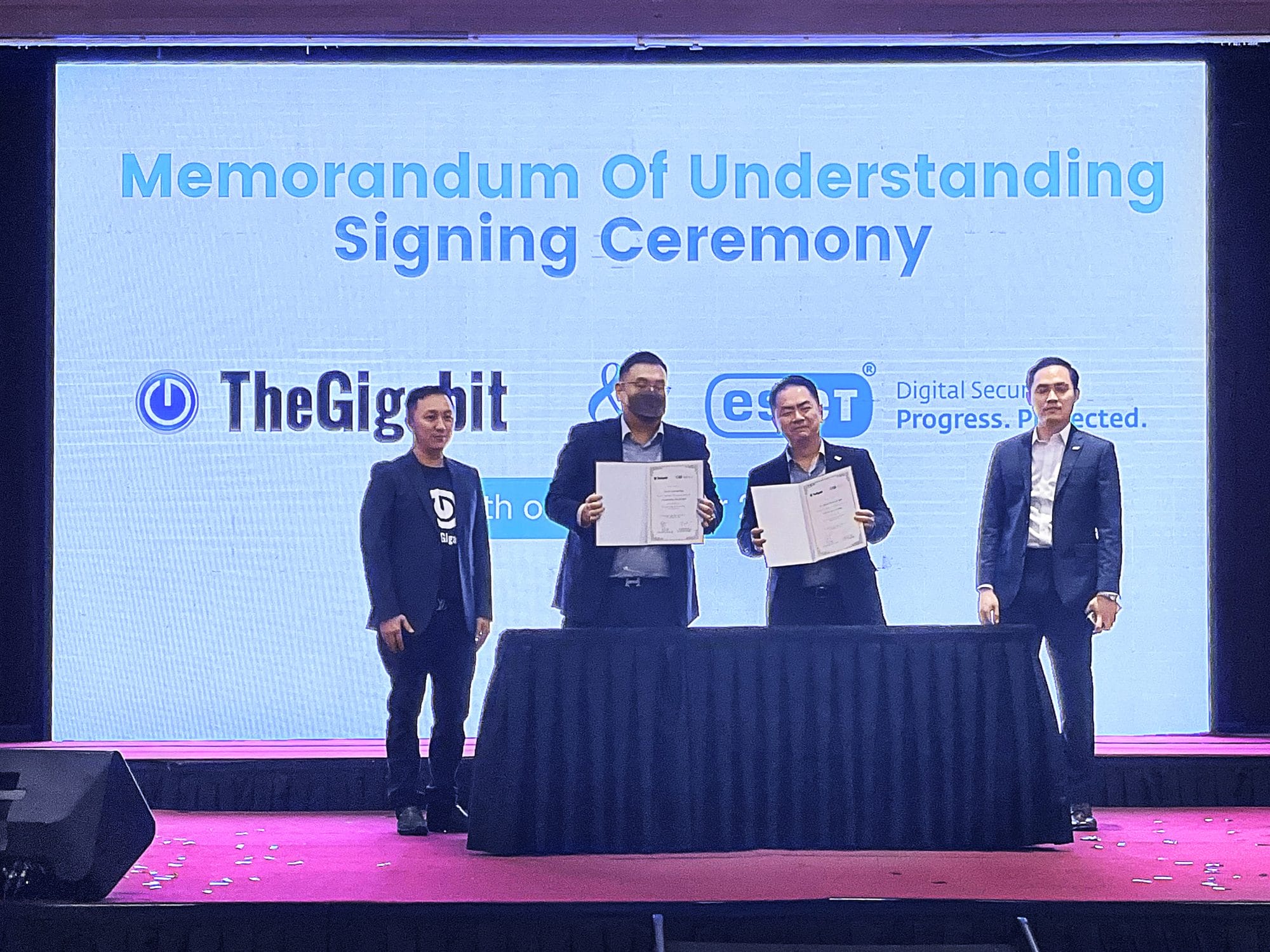
ESET’s database of malware and cybersecurity threats through its global threat intelligence database with real-time feedback from over 100 Million Endpoints. So, if something is out there, ESET would spot it.
On top of top-notch Global Threat Intelligence, ESET Inspect conducts root cause analysis to catch suspicious behaviour beyond known malware. Then, with ESET LiveGuard Advanced, suspicious applications are placed into Cloud Sandboxes to observe and analyse them.
“The thing I especially like about integrating ESET into TheGigabit’s services is how feather-light ESET’s applications are. Given how robust and versatile the ESET Protect Elite Suite is, it is really surprising how few resources it uses. It’s hyper efficient at what it does.”
After integrating with ESET, we so far haven’t had a single breach. So, we are very blessed to be under ESET’s protection. ET, to spot and protect against new threats, he said.
How DCs come into play
Let’s look at things from a top-down approach. You have the Internet or Network Infrastructure Tier. Without this, nothing is connected over the Internet, and businesses can’t function without being connected. Then, you have the Server tier, where all the applications are placed or installed to work. Without them, businesses would have nothing to run on.
Data Centres lie in between this bracket as without data centres, there is no good place for people to hold their servers as they serve as the bridge between the servers and the greater Internet.
Often, instead of placing expensive servers in a data centre, business owners often ask, can’t they just place their servers at their business premises? Well, the difference between hosting servers on-premise and in a data centre is two-pronged.
Firstly, there is the need for broadband. “When you host your servers in your building, you rely on your broadband provider’s best efforts to keep things running. As against a Service Level Agreement (SLA). So, if you aren’t getting the desired performance, the ISP is not responsible beyond their best efforts to keep things running. In contrast, Data Centers are bound by SLAs to give their listed performances regardless of any circumstances.
How do Data Centres maintain these SLAs? The answer is through redundancy. Data Centres providers build multiple layers of redundancy to ensure that if a network route fails or if there is a technical fault, a backup is ready to keep applications running smoothly.
Teoh said he can’t speak for other data centres but TheGigabit’s advantage is simple. “We own our network and own our suites. That means we have full control over our data centres and can keep things running smoothly without middlemen or secondary service providers.
If something happens, we have our on-site Network Operations Center and Security Operations Centre Teams to respond immediately and prevent any incidents. No long wait times for tickets to clear as our clients have access to expert support 24/7, just a phone call or WhatsApp away.
Furthermore, our data centers are part of a robust network across Asia. We have DCs in Malaysia, Hong Kong, Taiwan and Japan, with multi-100G capabilities and a total backbone network capacity of 1.2 TBps. We work with multiple upstream providers throughout the region to give our clients connectivity with the lowest possible latency.
Furthermore, we have auto-fine-tuned BGP Routing to ensure that if one Point of Presence is experiencing technical issues, we can bounce it to another one on our network without interrupting your server, he said.


