US stocks rallied to close out the trading week on Friday after Wednesday’s sharp decline due to Fed’s 25-basis point rate cut and two projected rate cuts in 2025, reported Reuters on Friday.
For the week, the S&P 500 fell 1.99%, the Nasdaq declined 1.78%, and the Dow Jones Industrial Average (DJIA) dropped 2.25%.
On Wednesday, the Fed announced its third interest-rate cut of the year but forecast in its summary of economic projections (SEP) two 25-basis point cuts for 2025 in a nod to the economy’s continued health and manageable inflation. Some Fed officials acknowledged they were starting to factor in fiscal policy uncertainty, such as tariffs, in their outlooks.
The announcement sparked a sharp sell-off on Wednesday. The Dow Jones Industrial Average (DJIA) dropped 1,123.03 points, or 2.58%, to 42,326.87, marking its 10th consecutive loss—the longest losing streak since 1974. The S&P 500 fell 178.45 points, or 2.95%, to 5,872.16,
The equity markets were unable to bounce back on Thursday and even with Friday’s rally, the three major US markets declined for the week.
On Friday, the DJIA rose 498.82 points, or 1.18%, to 42,841.06, the S&P 500 gained 63.82 points, or 1.09%, to 5,930.90, and the Nasdaq Composite gained 199.83 points, or 1.03%, to 19,572.60.
The DJIA and S&P recorded their biggest daily percentage gains in 44 days since Nov 6.
Friday’s session also marks the simultaneous expiry of quarterly derivatives contracts tied to stocks, index options and futures, also known as “triple witching,” which boosted trading activity.
Each of the 11 major S&P sectors advanced in the broad-based rally, led by a gain of 1.8% in real estate.
Small-cap stocks as measured by the Russell 2000 which are also seen as likely to benefit from lower interest rates, rallied 0.9%.
Advancing stocks outnumbered decliners by a 2.84-to-1 ratio on the NYSE and by a 2.12-to-1 ratio on the Nasdaq.
Volume on U.S. exchanges was 21.58 billion shares, compared with the 14.87 billion average for the full session over the last 20 trading days.
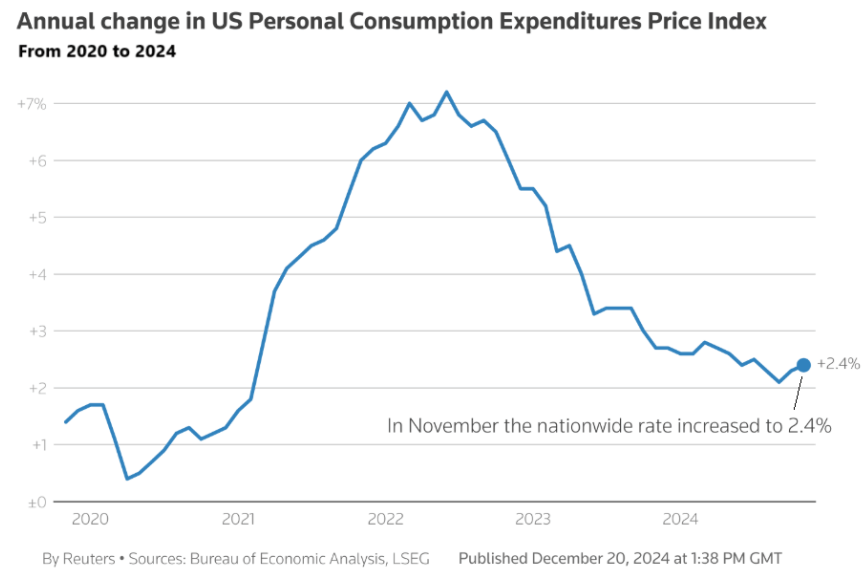
The latest inflation report in the form of the Personal Consumption Expenditure (PCE) index showed a 2.4% rise in November on an annual basis, just below the 2.5% estimate of economists polled by Reuters, a sign of economic resilience.