



ASEAN Taxonomy Version 3 with updated technical screening criteria for the construction and transportation sectors was released on Friday, incorporating feedback and suggestions from stakeholders up to October 2024 to further sustainability goals across the region, according to a press statement dated Dec 20 released by the ASEAN Taxonomy Board (ATB).
The updated iteration of the ASEAN Taxonomy for Sustainable Finance (ASEAN Taxonomy) includes technical screening criteria for the Construction & Real Estate and Transportation & Storage sectors which was sfirst published in March this year.
This updated ASEAN Taxonomy Version 3 has been effective since 20 December 2024. The ATB is encouraged by the positive responses from stakeholders, which mainly centered on refining the definitions, improving the usability of ASEAN Taxonomy, and strengthening awareness and capacity-building initiatives for its implementation.
Stakeholders also emphasised the importance of mutual recognition and credibility of taxonomies, calling for greater interoperability amid the growing number of taxonomies and guidances in existence.
Key revisions made to the ASEAN Taxonomy Version 3 include:
Terminologies used in the Technical Screening Criteria (TSC) for Construction & Real Estate have been revised to clearly define levels of recognition required to achieve the Green tier, supplemented by a non-exhaustive list of local and global green building certifications (GBC) to enhance clarity.
Terminologies used in the TSC for Transportation & Storage have also been finetuned to clarify the terms related to technological and economical feasibility, the transport of fossil fuels, infrastructure, and alternative fuels. Emphasis has been placed on the current basis of water transport activities.
The ATB believes that these amendments provide greater clarity for users of the ASEAN Taxonomy. Further, the ASEAN Taxonomy will continue to be reviewed and updated in line with evolving technological, scientific, and economic developments and in consultation with key stakeholders and users.
The ATB has also developed a Frequently Asked Questions (FAQ) document in response to stakeholder feedback to promote understanding and adoption of the ASEAN Taxonomy. This FAQ serves as a practical guide to address common queries, clarify the taxonomy’s purpose and application, and support its socialisation and uptake across the region. The FAQ is designed as a living resource, regularly updated to incorporate the latest developments, insights, and feedback from stakeholders.
Alongside the FAQ, the ATB has also published new Small & Medium Enterprise (SME) Use Cases for the ASEAN Taxonomy, covering the construction, agriculture, and manufacturing sectors to enhance usability and adoption, building on findings from stakeholder consultations and earlier versions. These use cases serve as practical references, designed to facilitate and encourage greater adoption and application of the Taxonomy by SMEs.
Background
The ATB was set up in 2021 with the support of the ASEAN Finance Ministers and Central Bank Governors’ Meeting (AFMGM) calling for furthering of a cohesive sustainable finance agenda across regional banking, capital markets and insurance fields.
Version 1 of the ASEAN Taxonomy was published in November 2021. The ATB called for stakeholder consultation after the publication and over 80% of respondents emphasised the need for a common language. The ASEAN Taxonomy provides alignment on underlying principles and helps harmonise the classification of sustainable activities and assets across the region.
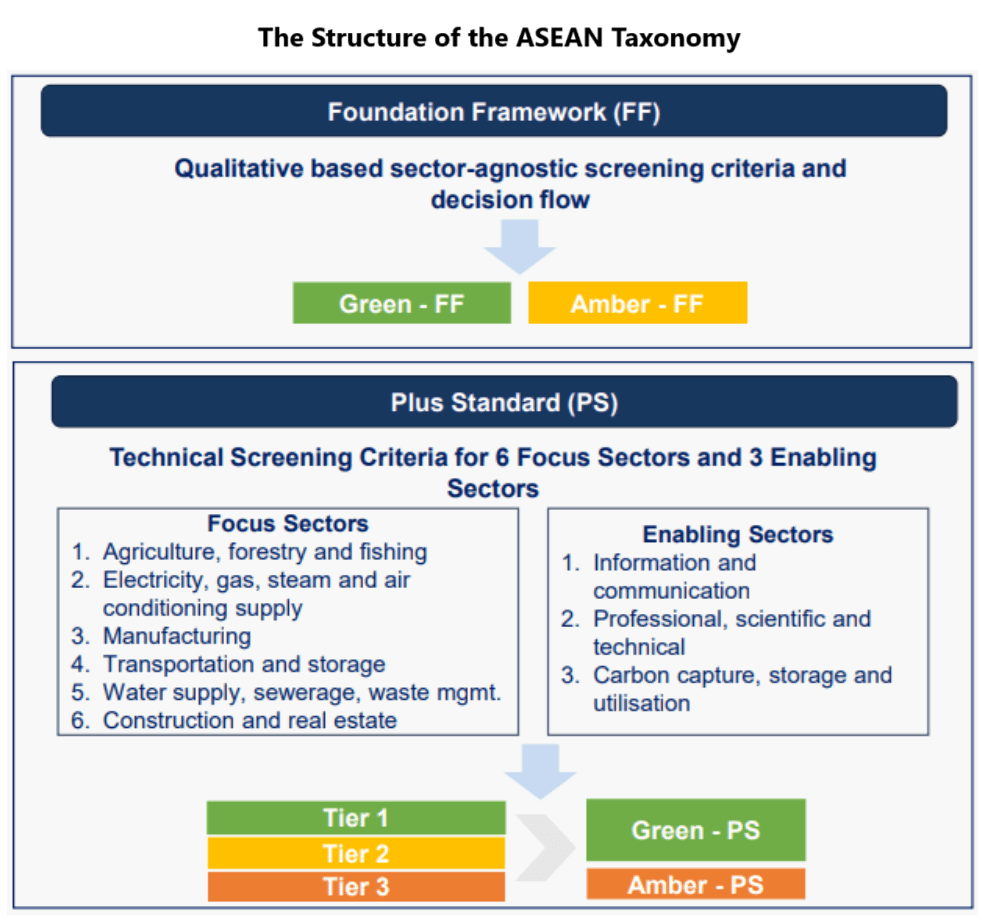
The ASEAN Taxonomy offers two assessment approaches, the Foundation Framework (FF) method that covers qualitative and sector-agnostic screening criteria, and the Plus Standard (PS) method that comprises technical screening criteria for six focus sectors and three enabling sectors.
The ASEAN Taxonomy is a crucial screening tool in achieving four Environmental Objectives (EO), namely, Climate Change Mitigation, Climate Change Adaptation, Protection of Healthy Ecosystems & Biodiversity, and Resource Resilience & Transition to a Circular Economy.
To be classified under the ASEAN Taxonomy, any activity must demonstrate that it contributes to at least one of these EOs. EO1 (Climate Change Mitigation) focuses on decarbonisation pathways for activities, requiring them to align
with decarbonisation trajectories in line with the Paris Agreement. EO2 (Climate Change Adaptation) concentrates on reducing the negative effects of climate change and increasing resilience through implementing processes or actions. EO3 (Protection of Healthy Ecosystems & Biodiversity) concentrates on protecting the natural ecosystem and biodiversity, promoting sustainable use of natural resources, and minimising adverse impacts on the environment. EO4 (Resource Resilience & Transition to a Circular Economy) focuses on promoting resource resilience and the transition to a circular economy through principles such as minimising resource use, optimising resource yield, and closing resource loops through effective waste management, which can be achieved by adjusting business operations and implementing circular economy principles via adapted products, production, technologies, and processes.
The current Board comprises representatives from all 10 ASEAN Member States, as follows:
- Brunei Darussalam Central Bank (Chair)
- Bangko Sentral ng Pilipinas (Vice-Chair)
- Insurance Regulator of Cambodia
- Non-Bank Financial Services Authority of Cambodia
- Financial Services Authority of Indonesia
- Bank of the Lao PDR
- Bank Negara Malaysia
- Securities Commission Malaysia
- Ministry of Planning and Finance of Myanmar
- Securities and Exchange Commission Philippines
- Monetary Authority of Singapore
- Bank of Thailand
- The Securities and Exchange Commission, Thailand
- State Securities Commission of Viet Nam
Sources: Sustainable Finance Institute Asia – https://www.sfinstitute.asia/asean-taxonomy/, Association of Southeast Asian Nations – https://asean.org/ & ASEAN Capital Markets Forum – https://www.theacmf.org/sustainable-finance/publications


