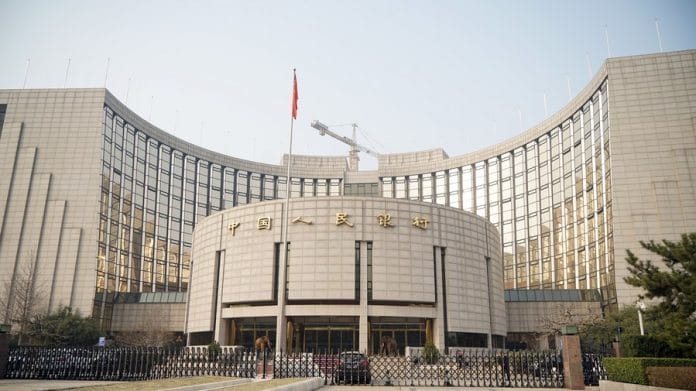
China’s central bank has injected significant short-term funds into its financial system, providing relief to lenders grappling with a cash squeeze as the Lunar New Year approaches. On Wednesday, the People’s Bank of China (PBOC) announced a net injection of 958.4 billion yuan (US$131 billion) through seven-day reverse repurchase agreements during daily open market operations.
This marks the second-highest injection recorded in data compiled by Bloomberg since 2004.
The liquidity operation aims to address the impact of medium-term lending expirations, the peak tax season, and increased cash demand ahead of the holiday period, according to a statement from the central bank. PBOC Deputy Governor Xuan Changneng affirmed that monetary tools, including interest rates and the reserve requirement ratio, would be employed to ensure liquidity remains ample.
Earlier this week, a cash crunch pushed seven-day interbank funding rates to their highest levels in more than a year. The sizable liquidity boost has eased concerns over the central bank’s ability to support the economy while maintaining its efforts to defend the yuan, which has been under pressure.
“The PBOC will likely continue to ramp up open market operations in 2025 as they seek to expand their monetary policy toolkit,” said Lynn Song, Greater China Chief Economist at ING Bank. Song noted that these operations influence liquidity without relying on more significant headline measures, such as interest rate or reserve requirement ratio adjustments, which may be reserved for more critical periods.
The reverse repurchase agreements partially replaced the expiration of medium-term financing of approximately 955 billion yuan. In recent months, the PBOC has leaned more heavily on the seven-day reverse repo rate rather than the medium-term lending facility (MLF) rate to guide market borrowing costs. The timing of MLF operations has also shifted later in the month, with reverse repos serving to moderate market volatility between maturities.
Following the liquidity injection, the seven-day repo rate, a key interbank borrowing benchmark, dropped 70 basis points to 1.6% at market opening. This followed a Tuesday close of 2.3%, the highest since October 2023.
The PBOC’s moves are part of broader efforts to stabilise the financial system and maintain sufficient cash flow during a seasonally tight period. However, market observers remain cautious about the central bank’s balancing act between supporting the economy and managing the yuan’s stability.