


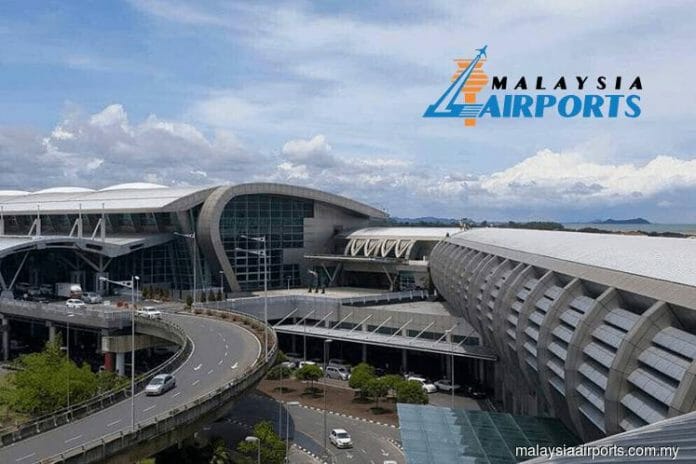
Malaysian Airports Holdings Berhad has released the 2024 and December passenger movements across its network of airports, with the total passenger movements growing 135 million passengers and reaching 96.1% recovery rate against pre-pandemic levels.
For December, the network saw an 11% jump in passenger movement to record 12 million in passenger movements across its airports.
The group said the impressive performance was partly attributed to strong air travel demand, expansion of airlines networks, particularly in the iinternational sector amid a challenging backdrop. Favourable travel policies, such as the 30-day visa-free entry for Chinese and Indian tourists visiting Malaysia, played a key role in supporting
the upward trend.
On the local front, MAHB noted that passenger movements at Malaysia Airports continued to display a robust growth trajectory in 2024, handling 93.8 million passengers, reaching 89.1% of 2019 levels. The strong traffic performance it added reflects the industry’s resilience amid capacity constraints encountered by airlines as a result of supply chain disruptions on aircraft and engine parts. These challenges caused a delay in new aircraft deliveries and backlogs in aircraft Maintenance, Repair, and Overhaul (MRO). Despite these challenges, international traffic thrived, recording 49.6 million passengers, trailing 2019 levels at 93.1%. The domestic sector it noted also continued to show notable growth, recording 44.2 million passengers, or 85.0% of pre-pandemic levels.
Air connectivity at Malaysia Airports saw 6.1% growth in 2024 with twelve new airlines and sixteen airlines resuming services, connecting to twenty-four (24) new destinations. Key markets with notable growth included China, Indonesia, and the Middle East. A total of 73 foreign carriers and 6 local carriers (excluding full freighters) operated to 138 international and 31
domestic destinations compared to 64 foreign carriers and 8 local carriers in 2023 that served 105 international and 34 domestic destinations. The average load factor for 2024 reached 80.0%, a 2.8 percentage point increase compared to 2023, highlighting strong demand for air travel.
MAHB noted that airline seat capacity for 2024 indicates an 11.4% increase compared to 2023, with the highest growth observed for Northeast Asia, followed by South Asia and the Middle East, indicating significant demand for air travel in these regions supported by the visa waiver, increasing trends in leisure as well as business travellers.
Looking ahead, MAHB said the Airport Council International (ACI) Advisory Bulletins (September 2024) forecasted that the Global and Asia Pacific passenger movements would increase by 10.0% and 13.0% over 2023, respectively, while the Global traffic in 2025 is forecasted at 6.3% over 2024 and averaging at 5.7% for 2026 to 2027.
While the International Air Transport Association (IATA) Global Outlook for Air Transport (December 2024 report) reported that traffic for 2024 for Global and Asia Pacific would grow by 10.7% and 15.6% over 2023, respectively, and 2025 is estimated to grow at 6.2% and 9.1% over 2024, respectively.
The Malaysian Aviation Commission’s (MAVCOM) Waypoint Report (October 2024) reported that 2024 air passenger traffic forecast (including Senai Airport) to fall between 95.4 million to 97.6 million passengers representing a year-on-year increase of between 12.2% to 14.9% against a lower-than-expected growth in seat capacity.

