


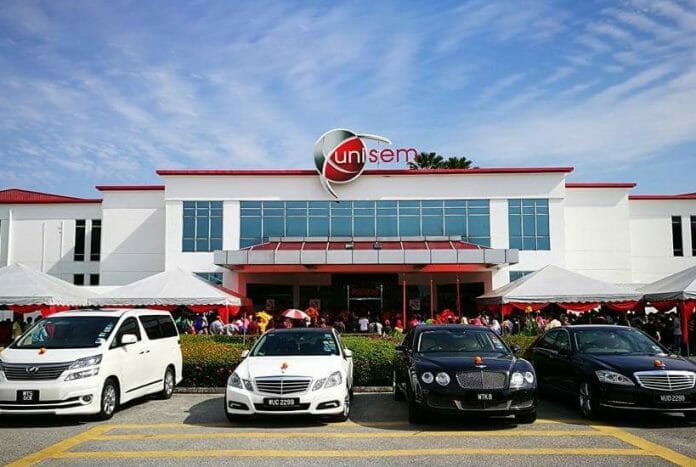
Despite strong performance from its Chengdu operations, semiconductor packaging and test services provider Unisem faces near-term headwinds as its Malaysian operations undergo consolidation and relocation, said CGS International in a research note.
The research house noted that Unisem Chengdu contributed roughly two-thirds of group revenue and the entirety of its net profit in the first half of FY2025 (1H25), reflecting sustained demand and higher utilisation rates exceeding 85%.
In contrast, Unisem Malaysia has remained below breakeven, weighed down by cost duplication across facilities and weak utilisation levels of around 55–60% since FY2023.
“We believe Unisem’s outlook remains cloudy through to mid-FY2026 due to the ongoing consolidation of its Malaysian operations,” CGS said.
“While the group is unlikely to benefit from near-term AI-driven demand due to its lower-end product mix, earnings recovery could materialise in late FY2026 as key customers ramp up their ‘China+1’ diversification efforts.”
Relocation from Simpang Pulai to Gopeng
The firm added that UM’s profitability will continue to be pressured over the next six to nine months as it relocates operations from its older Simpang Pulai (SP) facility to the newer Gopeng plant.
Although Gopeng’s floor space is about 50% larger, its utilisation remains low, accounting for only 10–15% of UM’s sales in 1H25. CGS expects 4Q25 to remain challenging as Unisem transfers SP’s existing customers to Gopeng over the next two to three quarters.
While cost savings are expected once the consolidation is complete, UM is projected to achieve breakeven only by the second half of FY2026, at the earliest.
CGS also highlighted management’s guidance that Unisem’s largest Chengdu customer plans a substantial ramp-up in volume loading at the Gopeng facility in FY2026 — a development that could support recovery momentum.
Earnings and Valuation Outlook
Reflecting the impact of the relocation, CGS trimmed its FY2025 earnings per share (EPS) forecast by 32%, but raised its FY2026F and FY2027F EPS estimates by 17% and 21%, respectively, anticipating a rebound in EBIT margins to pre-FY2020 levels.
The research firm also shifted its valuation methodology from a Gordon Growth Model (GGM) to a price-to-earnings (P/E) framework, citing “prevailing liquidity-driven market dynamics” and the need for consistency with cyclical sector valuation norms.
Based on this, CGS raised its target price (TP) to RM1.90 (from RM1.00 previously), pegged to 25.6x FY2026F P/E, the five-year blended forward mean. Despite the higher TP, the firm maintains its “Reduce” rating on valuation grounds.
Unisem shares have surged 51% since July 2025, now trading at 46.3x FY2026F P/E — about three standard deviations above its five-year mean.
The house believes the TP peg to mean is justified despite near-term challenges, as we expect core profit recovery in FY2027F to approach the FY2020–2024 baseline average of RM173.7 million.
Risks and Catalysts
Potential upside risks include a stronger-than-expected recovery in consumer electronics demand, new customer wins, and a weaker ringgit against the US dollar.
Downside risks, however, stem from prolonged consumer softness and the company’s inability to scale new growth drivers in the near term.


