


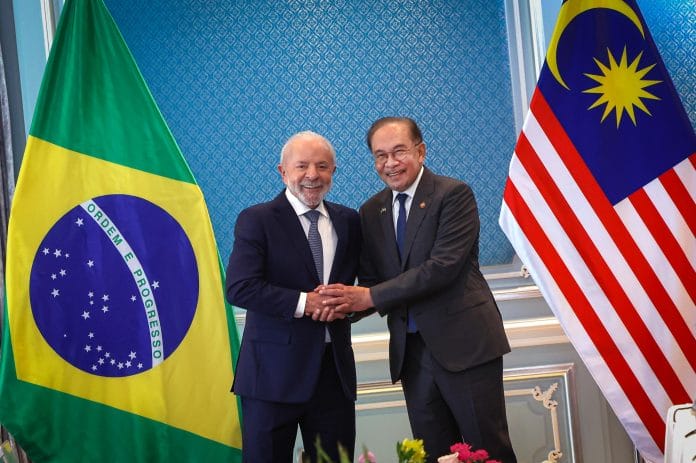
Malaysia and Brazil have taken a major step toward deepening their diplomatic and economic ties following the official visit of Brazilian President Luiz Inácio Lula da Silva to Malaysia at the invitation of Prime Minister Datuk Seri Anwar Ibrahim.
The visit — President Lula’s first to Malaysia — underscored more than six decades of friendship since the two nations established diplomatic relations in 1959, highlighting their shared commitment to peace, sustainable development, and multilateral cooperation.
Towards a Strategic Partnership
Both leaders reaffirmed the positive momentum in Malaysia–Brazil relations, noting the growing number of high-level exchanges, ministerial visits, and cooperation across key sectors. They agreed to explore elevating the relationship to a strategic partnership in the near future.
In a joint statement, Anwar and Lula pledged to enhance collaboration in trade and investment, semiconductors, energy transition, science and innovation, agriculture, education, and environmental sustainability. The next Bilateral Consultation Meeting will be held in Brasília, providing a platform to further advance these initiatives.
Boosting Economic and Investment Links
Both sides committed to fostering a more conducive environment for trade and investment, including through enhanced market access, business connectivity, and supply chain resilience.
The leaders highlighted ongoing negotiations on a Double Taxation Avoidance Agreement (DTAA), which will help reduce fiscal barriers and promote cross-border investment once concluded.
Two Memoranda of Understanding (MoUs) were signed during the visit — one on semiconductors and another on science, technology, and innovation — paving the way for joint research, industrial partnerships, and technology transfer between both countries.
In the semiconductor space, Malaysia’s MIMOS inked agreements with Brazil’s National Space Research Institute (INPE) and the Renato Archer Information Technology Centre, expanding cooperation in advanced electronics and digital infrastructure.
Expanding Cooperation in Agriculture and Health
The two nations also agreed to deepen cooperation in agriculture, food security, and biotechnology, including through a Letter of Intention between MARDI and EMBRAPA, Brazil’s leading agricultural research agency.
Both sides welcomed progress on Brazil’s poultry and fishery exports to Malaysia following the country’s declaration of High Pathogenic Avian Influenza (HPAI)-free status, and expressed a shared interest in addressing the anti-dumping measures affecting Malaysia’s rubber glove exports to Brazil.
On health cooperation, the leaders reaffirmed their intent to collaborate on vaccine production, disease prevention, and regional medical security, building on initiatives like the Dengue Alliance.
Climate Action and Green Transition
Anwar and Lula jointly reaffirmed their commitment to climate action and sustainable growth, emphasising the need for a just energy transition that reflects the priorities of the Global South.
Malaysia expressed strong support for Brazil’s COP30 Presidency in Belém, Amazonia, and the upcoming Belém Declaration on Hunger, Poverty, and Human-Centered Climate Action.
Both countries will also collaborate through the Tropical Forest Forever Facility (TFFF), a new global initiative to fund large-scale tropical forest conservation. They highlighted biofuels and renewable energy as critical components of their shared decarbonisation strategy.
Shared Positions on Global Governance and Peace
The two leaders called for comprehensive reform of global governance institutions, including the United Nations (UN) and UN Security Council, to ensure greater representation of developing countries. Anwar reaffirmed Malaysia’s support for Brazil’s aspiration to become a permanent member of a reformed Security Council.
Both countries also expressed their strong support for Palestine, welcoming the ceasefire agreement in Gaza and emphasising the need for a two-state solution based on pre-1967 borders. They also endorsed Brazil’s participation in South Africa’s genocide case against Israel at the International Court of Justice (ICJ).
Expanding Strategic and People-to-People Ties
Defence cooperation was identified as a new area of engagement, with both nations exploring a Memorandum of Understanding on Defence Cooperation.
In the diplomatic field, Brazil’s Instituto Rio Branco (IRBr) and Malaysia’s Institute of Diplomacy and Foreign Relations (IDFR) exchanged notes to strengthen training and academic collaboration, while the Alexandre de Gusmão Foundation (FUNAG) and Institute of Strategic and International Studies (ISIS Malaysia) signed an MoU to foster joint research in foreign policy and strategic affairs.
A New Chapter in Malaysia–Brazil Relations
President Lula expressed his appreciation to Prime Minister Anwar and the Malaysian government for their hospitality and reaffirmed Brazil’s support for Malaysia’s ASEAN Chairmanship.
He also welcomed Malaysia’s aspiration to join BRICS, underscoring both countries’ shared goal of building a more equitable, multipolar world order rooted in South–South cooperation.
The visit concluded with both leaders pledging to build a stronger, greener, and more resilient partnership, one that positions Malaysia and Brazil as key voices for the Global South in shaping the future of global trade, climate policy, and inclusive development.


