


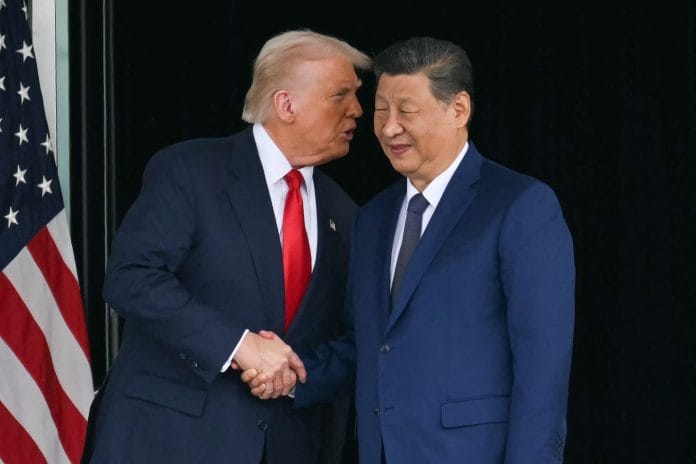
China’s Xi Jinping and U.S. President Donald Trump held a high-stakes phone conversation on Wednesday (4 February). While state media outlet Xinhua confirmed the call took place, the lack of a detailed readout suggests a relationship that remains strictly transactional as both superpowers prepare for a year of intense negotiation.
The call comes at a critical juncture. The world’s two largest economies are currently operating under a one-year trade moratorium struck in late 2025, which paused the escalating tariff wars of the previous year. However, even as the phone lines remain open, the “battle for the future” is shifting from port fees to the very elements that power modern technology.
The primary context for Wednesday’s discussion could have been on the November 10, 2025, truce, where the Trump administration suspended additional reciprocal tariffs on Chinese goods until November 10, 2026. In exchange, Beijing agreed to massive agricultural purchases—including 25 million metric tons of soybeans annually through 2028—and tightened controls on fentanyl precursors.
While tariffs have reached a temporary stalemate, rare earth minerals have emerged as the new point of friction. China currently processes roughly 90% of the world’s rare earths, a “chokehold” that President Trump has vowed to break.
The phone call notably occurred just 48 hours after President Trump unveiled “Project Vault,” a $12 billion strategic mineral reserve. Funded by a $10 billion loan from the U.S. Export-Import Bank and nearly $2 billion in private capital, Project Vault is designed to protect U.S. manufacturers from the kind of export bans Beijing utilized during the peak of 2025’s trade tensions.
Simultaneously, Secretary of State Marco Rubio is hosting the inaugural Critical Mineral Ministerial in Washington this week. Representing more than 50 nations, the summit is an explicit effort to create a “non-China” supply chain.e.
The “cold peace” between Washington and Beijing is set to be tested throughout 2026. While the tariff moratorium provides a breather for global markets, the aggressive rollout of Project Vault and the Washington Mineral Ministerial suggests that the U.S. is not merely waiting for the moratorium to expire—it is actively building an economy that no longer needs it.


