


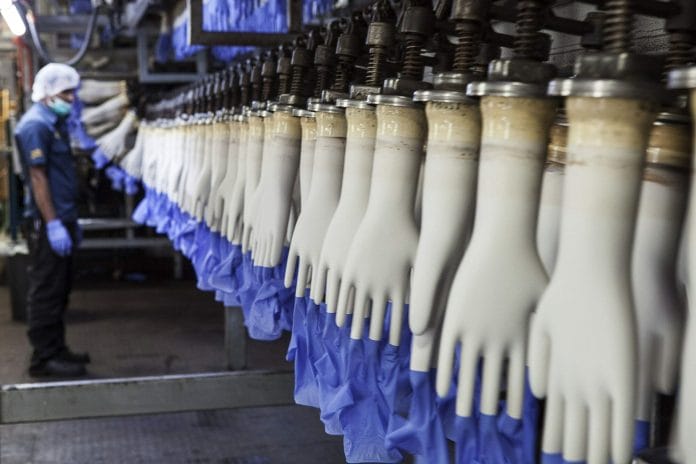
The closure of the Strait of Hormuz amid escalating hostilities in the Middle East has triggered a sharp spike in key raw material costs for the global glove industry, according to a research report by CGS International.
Prices of nitrile feedstock have surged between 23% and 44%, while latex raw materials have climbed 10% to 15% as of 17 March 2026, driven by supply disruptions, product substitution trends and rising freight costs. The brokerage expects the energy-driven dislocation to persist for six to eight weeks, after which raw material prices could gradually ease.
Margins seen stable as producers raise prices
Despite the cost pressures, CGS expects Malaysian glove manufacturers to maintain operating margins by passing higher input costs on to customers through increased average selling prices (ASPs). The report noted that inflationary pressures are industry-wide, allowing producers to adjust pricing without significantly eroding earnings before interest and tax (EBIT) margins per 1,000 pieces.
The sector’s sourcing structure leaves it broadly exposed to regional energy shocks. Malaysian glove makers are estimated to source about 50% of raw materials within ASEAN — mainly Malaysia and Thailand — and the remaining 50% from the wider Asia-Pacific region, including South Korea, China, Japan and India.
However, with an estimated two-month buffer of lower-cost nitrile butadiene rubber (NBR) inventory, CGS believes the immediate profit impact from supply disruptions will be limited. Price adjustments for Malaysian producers are likely to become more visible from the second quarter of 2026 onwards.
The report cautioned that the main downside risk would arise if the price dislocation extends beyond the expected timeframe, potentially dampening global glove demand as customers react to rising ASPs with reduced order volumes.
Sector valuations seen ahead of recovery
CGS reiterated its Underweight stance on the Malaysian glove sector, noting that current valuations appear to have priced in a stronger earnings recovery than fundamentals justify. The brokerage estimates the sector is trading at a forward price-earnings ratio of 14.7 times for CY2027, while projected return on equity of 5.5% remains well below pre-pandemic levels of 18%–24% recorded between 2012 and 2019.
Among listed players, Top Glove Corporation remains CGS’s preferred exposure to the sector, given its relatively lower valuation of 13.8 times CY2027 earnings and diversified product portfolio. The group is seen as better positioned to capture customer substitution trends, particularly any shift from nitrile to latex gloves.
Key risks and catalysts
Potential upside catalysts include a macro-driven surge in glove demand, accelerated rationalisation of legacy manufacturing capacity, and tariff increases affecting non-Malaysian producers.
Conversely, risks to sector performance include a stronger ringgit against the US dollar, which could erode export earnings, as well as continued capacity expansion that may prolong the current oversupply environment.


