


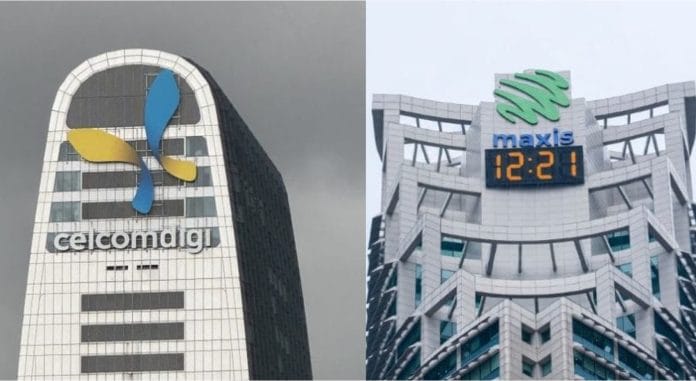
Malaysia’s mobile telecommunications sector is facing mounting competitive pressures as the integration of Digital Nasional Berhad (DNB) begins to reshape industry earnings dynamics, according to a latest research note by CGS International.
The research house said the recent decline in the market capitalisations of Maxis Berhad and CelcomDigi Berhad since end-February 2026 was largely due to investors starting to price in the impact of equity-accounting losses from DNB beginning FY2026.
CGS noted that its FY2026 to FY2028 core net profit forecasts for both telecom operators were lowered by between 0.4% and 7.8% following the completion of the DNB acquisition, which is expected to take effect in the second half of 2026.
However, the research firm believes part of the earnings pressure could be mitigated from 2027 onward as Maxis and CelcomDigi are expected to rent network elements to DNB. At the same time, lower capital expenditure requirements could emerge as future 5G investments would largely be undertaken by DNB instead of the operators directly.
CGS said this differs from its earlier expectation that Maxis and CelcomDigi would eventually roll out their own independent 5G networks.
Despite the DNB-related earnings concerns, CGS highlighted that competitive risks posed by U Mobile remain the larger long-term challenge for the sector.
The research house said U Mobile’s planned 5G rollout could potentially provide the operator with a lower-cost structure, enabling it to offer more competitive pricing once its network reaches scale around 2028.
CGS pointed to Telekom Malaysia Berhad’s recent decision to switch to U Mobile’s network as evidence that competitive dynamics in the industry may intensify further.
According to the report, incumbent players such as Maxis and CelcomDigi may attempt to defend market share through mobile virtual network operator (MVNO) strategies, although CGS warned that similar approaches in Singapore previously resulted in significantly weaker profitability for established telecom operators.
Reflecting the heightened competition risks, CGS raised its beta and cost-of-equity assumptions for both Maxis and CelcomDigi, resulting in lower target prices.
The research house cut its target price for Maxis to RM3.72 from RM4.00 previously, while CelcomDigi’s target price was reduced to RM3.10 from RM3.38. Both stocks retained a “Hold” recommendation.
CGS maintained a “Neutral” stance on the Malaysian telecommunications sector overall, citing a cautious outlook on mobile operators despite attractive valuations.
Instead, the research house said it prefers Telekom Malaysia and Axiata Group Berhad within the sector.
Telekom Malaysia was identified as CGS’s top pick, supported by strong projected returns on equity and dividend yields, while Axiata’s ongoing asset monetisation programme is expected to help narrow its discount to revised net asset value.
CGS said key downside risks for the mobile telecom sector include a sharper escalation in price competition driven by U Mobile’s market share ambitions and potential regulatory intervention limiting operators’ ability to pass rising costs onto consumers.
On the upside, the research house said higher operating costs could force smaller MVNOs out of the market, potentially improving pricing power and earnings visibility for larger incumbents over the longer term.


