


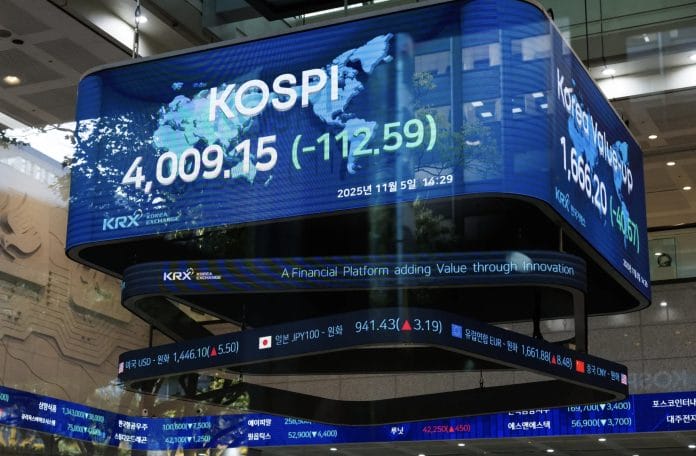
South Korea’s benchmark Kospi index fell, as rising bond yields threaten the world’s hottest stock rally driven by artificial intelligence.
The Kospi tumbled as much as 4.7% on Monday shortly after the opening bell, extending its two-day drop to more than 10% and briefly entering correction territory. The Korea Exchange halted Kospi program selling after a sharp slump in futures. The benchmark has since clawed back some of those early losses and is down less than 2%.
The latest swings highlight once again the fragility of a market relying on the advance of heavyweights Samsung Electronics Co. and SK Hynix Inc. Global investors reduced a record $13 billion worth of Korean equities last week as they took profit following a sharp surge in the two memory makers. Stocks were falling across Asia on Monday as rising global bond yields on inflation fears sapped risk demand.
The decline is “a natural pullback” following the index’s sharp rally over the past month, said Ha SeokKeun, chief investment officer at Eugene Asset Management.
Focus is also on Samsung’s negotiation with its largest labor union resuming on Monday to avert a strike that the nation’s prime minister warned could wreak havoc on the economy. Management and the union representatives will meet for the talks on wages and compensation, with Samsung having reported operating profit that soared on AI-driven demand for its semiconductors.
Samsung reversed its earlier loss to rise more than 3% after President Lee Jae Myung made comments that management rights must be respected just as much as labor rights.
“The immediate triggers were rising interest rates and Samsung Electronics’ labor strike,” Ha said. “However, we do not see this as the beginning of a structural downtrend, but rather a healthy price correction. In fact, we believe attractive buying opportunities in high-quality stocks are emerging again.”
Intraday gyrations of 5% or more have become more common in the Korean market, with leveraged bets tied to Samsung and SK Hynix amplifying volatility. Underscoring the torrid pace of this year’s rally, the Kospi jumped from 7,000 to 8,000 in just seven sessions. In contrast, it took more than 18 years for the benchmark to climb from 1,000 to 2,000, and another 13 years to reach 3,000.
Foreign funds were selling Kospi shares again Monday, while retail investors increased holdings.
Bloomberg


