


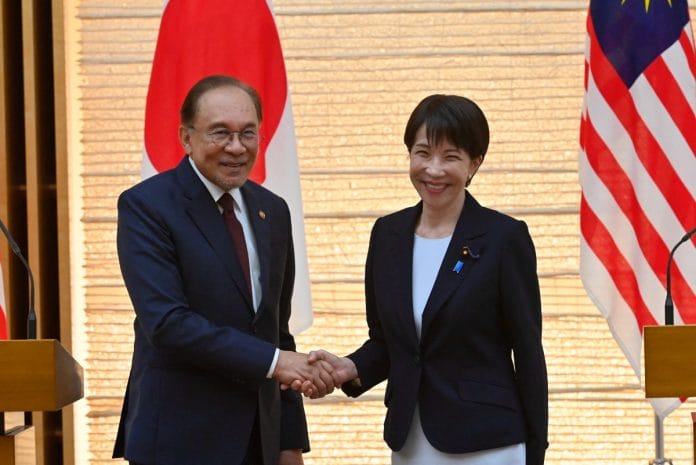
Malaysia and Japan have elevated their economic partnership beyond traditional trade ties, unveiling a broad agenda spanning artificial intelligence (AI), energy security, critical minerals and advanced manufacturing following a bilateral summit between Prime Minister Datuk Seri Anwar Ibrahim and Japanese Prime Minister Sanae Takaichi.
The biggest takeaway from the meeting was a shared commitment to future-proof both economies through deeper industrial collaboration, with the two countries agreeing to establish a Japan-Malaysia AI Platform linking companies and startups to drive innovation and address societal challenges. The leaders also backed closer cooperation in semiconductors, green technologies and startup ecosystems.
Energy security emerged as another key pillar, with both nations pledging stronger cooperation under the newly launched Partnership on Wide Energy and Resources Resilience Asia and the Asia Zero Emission Community framework. Malaysia reaffirmed its role as a reliable supplier of LNG, petroleum products and other strategic resources to Japan amid growing geopolitical uncertainties.
The summit also delivered momentum for critical minerals and supply-chain resilience, with both sides agreeing to deepen cooperation on rare earths and strategic resources while streamlining regulatory processes to strengthen regional manufacturing competitiveness.
Beyond economics, the leaders agreed to accelerate defence technology cooperation, strengthen maritime security collaboration and expand cooperation against transnational crimes, underscoring a broader strategic convergence between Kuala Lumpur and Tokyo.
As Malaysia and Japan approach the 70th anniversary of diplomatic relations in 2027, the meeting signals a shift from a relationship historically anchored by the Look East Policy to one increasingly focused on AI, clean energy, economic security and regional resilience.

